

Amaranth
Amaranthus retroflexus
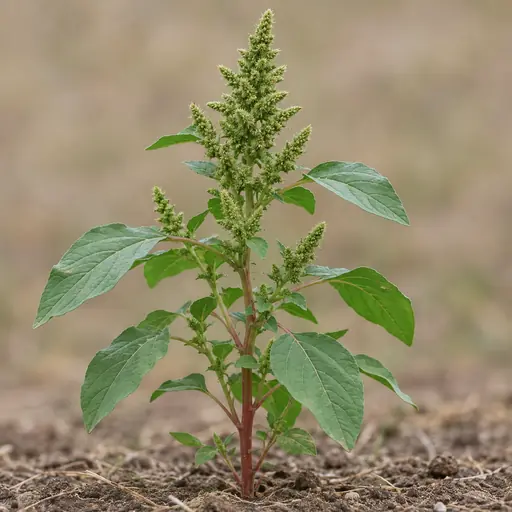
A leafy plant often taken for a weed. Its leaves and seeds are edible and full of nutrients.
How to recognise it
Redroot amaranth, or pigweed, is a stout, upright annual. Its stem is covered in fine white hairs and is red at the base. The taproot is pink to red. The leaves grow alternately and are oval to diamond-shaped, smooth-edged and long-stalked. They often have a small notch or a tiny point at the tip. The tiny green flowers sit in dense, bristly, prickly spikes. Later these hold tiny, shiny black seeds. Two toxic weeds share its ground. Thorn apple (Datura) has large, coarsely toothed leaves that smell foul, white trumpet flowers and spiny pods. Black nightshade has wavy-edged leaves, small white star flowers and black berries.
Where it grows
Look in gardens, fields and farmyards and on waste ground. It wants bare, rich, disturbed soil in full sun. It is native to central and eastern North America. Today it is a common weed across the US and much of Europe, most of all in warm lowlands.
When
This is a summer annual. It comes up in late spring once the soil warms. It flowers from about July to September. The seed ripens from August to October, until the first frost. The leaves are best young, before the plant flowers.
Picking
Pick the young leaves and tender tops by hand before flowering. Once the seeds are black, rub them out of the seed heads. Stay away from roadsides and sprayed fields. Skip heavily manured or fertilised ground and drought-stressed plants. Those build up the most nitrate.
Cooking
Make sure of your identification first. Then cook the leaves like spinach. Boil them briefly and pour the water away, which lowers their nitrate and oxalate. Eat them in moderation. Don't eat them at all if you have kidney stones or kidney disease. They taste mild and earthy and go well with garlic, beans and eggs. You can toast the seeds or cook them like a grain.
Keeping
The leaves wilt within a day. Keep them in a bag in the fridge, or blanch and freeze them. Dry the seed heads in a paper bag. Then rub out the seeds, winnow them and store them in a closed jar.
Toxic look-alikes
- Datura stramonium · Deadly - do not eat
- Solanum nigrum · Toxic - do not eat
Sources: Identification and season: Cornell University and NC State Extension. Nitrates and oxalates: NC State Extension and Michigan State University Extension. Thorn apple mix-ups: Marseille poison control centre.
Always consult an expert before consuming any wild food. This information is for educational purposes only.