

Shaggy Mane
Coprinus comatus
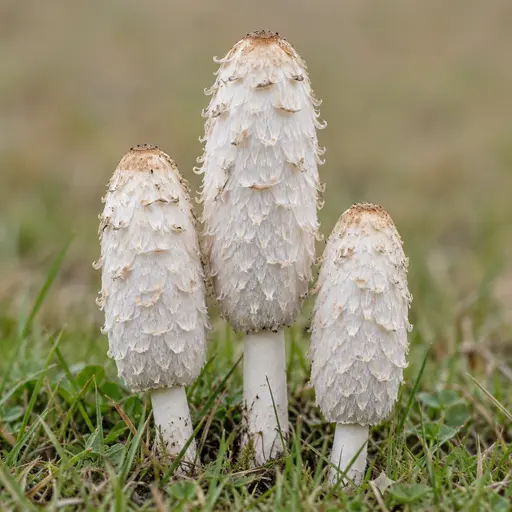
A tall white cylinder covered in shaggy scales, on lawns and roadsides. Within a day of picking it melts into black ink.
How to recognise it
The shaggy mane is a tall white cylinder, 5 to 15 cm high. It is covered in shaggy, upturned scales, with a pale brown top. With age it opens into a bell. The crowded gills turn from white to pink to black. Then they dissolve into black ink, from the cap edge upwards. The white stem is smooth and hollow. Its thin ring slides and often drops to the base. The spore print is black. The common ink cap (Coprinopsis atramentaria) has a smooth, grey-brown, finely grooved cap with no shaggy scales. It grows in clusters from buried wood. On US lawns, young green-spored parasols (Chlorophyllum molybdites) can look similar. Their gills never turn black.
Where it grows
Look on lawns, verges, parks, paths, building sites and other disturbed, grassy ground. It often grows in rows or groups. It is common across Europe and North America.
When
It comes mainly in late summer and autumn, a few days after rain. It comes again in spring. On the US Pacific coast it carries on through the mild, wet winter.
Picking
Take only young, closed caps that are white all over, with white gills. Take only what you will cook the same day. Avoid busy roads, dumps and polluted ground, because it takes up heavy metals.
Cooking
When you're certain of the identification, cook it within a few hours. Cut away any pink or black part, which turns bitter. Sauté it in butter, or add it to soups and omelettes. It is mild and delicate. It is not known to react with alcohol. But the common ink cap does, even with drinks taken days before or after the meal. If you are unsure which ink cap you have, do not eat it.
Keeping
It does not keep. Within a day it turns to ink, even in the fridge. Cook it straight away. Cooked, it keeps a day or two in the fridge, or you can freeze it.
Toxic look-alikes
- Chlorophyllum molybdites · Toxic - do not eat
- Coprinopsis atramentaria · Toxic - do not eat
Sources: Identification and habitat: First Nature and Missouri Department of Conservation. Alcohol reaction: First Nature. Season: GBIF records.
Always consult an expert before consuming any wild food. This information is for educational purposes only.