

Winter Chanterelle
Craterellus tubaeformis
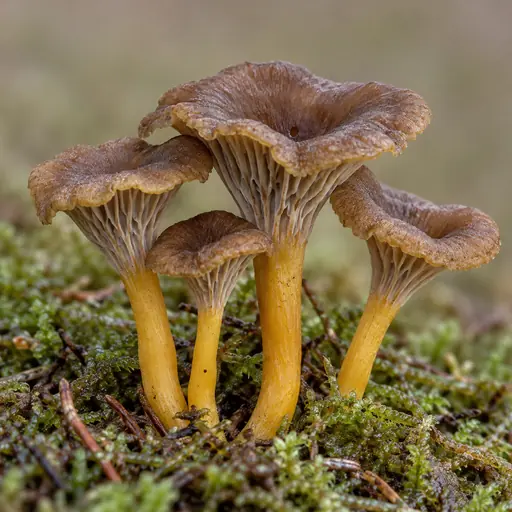
A small chanterelle with a brown cap on a hollow yellow stem. It keeps fruiting through the first frosts.
How to recognise it
The winter chanterelle is small and slim. The cap is 1 to 4 cm, brown to yellow-brown. It is a thin funnel and its centre opens into the hollow stem. Underneath are blunt, forking ridges, grey to yellowish-grey, that run down the stem. The stem is yellow to orange-yellow, hollow and often flattened or grooved. The deadly webcap (Cortinarius rubellus) grows in the same mossy conifer woods. It has a pointed red-brown cap and true rusty-brown gills. Its stem is solid, with faint yellow bands. It destroys the kidneys. Check every mushroom as you pick and again as you clean. Norway's poison centre advises throwing away the whole basket if you find even one webcap in it.
Where it grows
It grows on wet, acid ground in conifer woods, mainly under spruce and pine. Look in moss, at bog edges and on moss-covered rotten logs. It is common in northern and central Europe and in the mountains of the south. In North America it grows in the Pacific Northwest and northern California. It also grows in the northern and eastern conifer forests.
When
It comes late in the year. In Europe it fruits from September until hard frost, often still in November and December. On the US Pacific coast it runs from autumn through winter. It needs a wet autumn and light frosts do not stop it.
Picking
Cut the stems above the moss to keep the basket clean. Leave the smallest ones. Keep to local limits, such as small amounts for your own use in Germany. In southern Bavaria and the Bavarian Forest it still carries caesium from Chernobyl. There, eat it only now and then.
Cooking
Make sure of the identification first. Then split the hollow stems and rinse out needles and grit. Never eat it raw. Cook it well, in butter, sauces or soups, or with game. It tastes earthy and stronger than its size suggests.
Keeping
It keeps a few days in the fridge in paper. It dries very well and keeps its flavour for months in a closed jar. You can also cook it and freeze it.
Toxic look-alikes
- Cortinarius rubellus · Deadly - do not eat
- Omphalotus olearius · Toxic - do not eat
- Omphalotus illudens · Toxic - do not eat
- Omphalotus olivascens · Toxic - do not eat
- Omphalotus subilludens · Toxic - do not eat
- Hygrophoropsis aurantiaca · Not edible
Sources: Identification: MykoWeb (California Fungi) and First Nature (UK). Deadly webcap: Norwegian Institute of Public Health. Caesium: German Federal Office for Radiation Protection (BfS). Season: GBIF records.
Always consult an expert before consuming any wild food. This information is for educational purposes only.