

Porcini
Boletus edulis
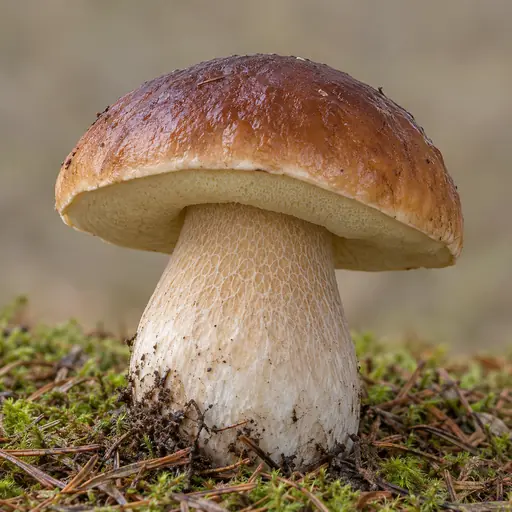
The porcino: a stout mushroom with a brown cap, a pale netted stem and white pores that never bruise blue.
How to recognise it
This is a stout bolete with a pale to chestnut-brown cap. The cap is smooth and greasy but never velvety. It often has a thin whitish rim. The pores are white when young, then turn yellow and olive. They do not change colour when you press them. The pale stem has a fine white net near the top. The white flesh does not change colour when cut. Pink pores and a dark brown net mean the bitter bolete (Tylopilus felleus). Red or orange pores mean another bolete that may be toxic. So does flesh that turns blue.
Where it grows
It grows with spruce, pine, beech, oak, sweet chestnut and birch on acid soil. You find it from the lowlands to the tree line, all across Europe. In North America it grows mainly in the Pacific states. In the southern Rockies the redder Rocky Mountain king is commoner.
When
The main season is August to October. In the mountains it starts in June and in the south it lasts into November. On the US Pacific coast it comes with the autumn rains. A flush usually comes about two weeks after a soaking rain that follows a warm, dry spell.
Picking
Twist it out or cut it at the base. Leave the buttons and the old or maggoty caps. Germany allows only small amounts for your own use. Most Italian regions require a permit. Each US national forest sets its own rules.
Cooking
First make sure you have identified it with certainty. Brush it clean and slice it lengthwise to check for maggots. Fry it, or use it in risotto, pasta and soups. Cook it through. Not everyone tolerates it raw and old or badly stored ones upset the stomach.
Keeping
Keep it cool, in paper rather than plastic, for a day or two. It dries very well in thin slices and it freezes well too.
Toxic look-alikes
- Rubroboletus satanas · Toxic - do not eat
- Rubroboletus rhodoxanthus · Toxic - do not eat
- Neoboletus subvelutipes · Toxic - do not eat
- Boletus sensibilis · Toxic - do not eat
- Boletus huronensis · Toxic - do not eat
- Rubroboletus pulcherrimus · Toxic - do not eat
- Rubroboletus eastwoodiae · Toxic - do not eat
- Rubroboletus legaliae · Toxic - do not eat
- Tylopilus felleus · Not edible
- Tylopilus rubrobrunneus · Not edible
- Tylopilus plumbeoviolaceus · Not edible
Sources: Identification and habitat: Regione Piemonte, First Nature and MushroomExpert. Season: GBIF records. Rules: BArtSchV (Germany) and US Forest Service. Cooking: Regione Piemonte and VIDAL.
Always consult an expert before consuming any wild food. This information is for educational purposes only.