

Dandelion
Taraxacum officinale
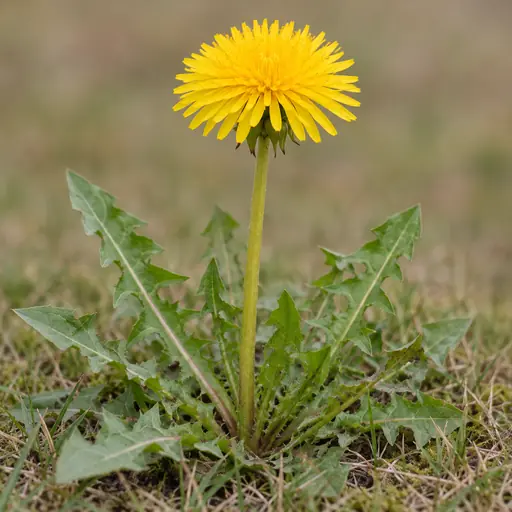
A common weed with bright yellow flowers. Its leaves are edible.
How to recognise it
Dandelion grows as a rosette at ground level. The leaves are hairless and deeply, raggedly lobed. Their teeth point back towards the centre. Leaves and stalks bleed white milky sap when you break them. Each flower stalk is leafless, unbranched and hollow. It carries one head of yellow, strap-shaped florets. Later comes a round white seed clock. Cat's-ear has branched, solid stalks and hairy leaves. Hawkbits have forked hairs on the leaves. Sow-thistles carry several flowers on leafy stems. Only pick plants that match every point.
Where it grows
It grows in lawns, meadows, pastures, verges and waste ground, in sun, from the lowlands into the mountains. You find it almost everywhere in Europe. It was brought from Europe to the US and now grows throughout the country.
When
A big flush of flowers comes in early spring, mainly in April and May. In the mild south it comes earlier. After that, flowers appear on and off until autumn. The leaves are least bitter in early spring, before the first buds appear.
Picking
Cut young leaves at the base. Pick the flowers on a sunny day when they are fully open and leave plenty for early bees. Avoid lawns treated with weedkiller, roadsides and places where dogs are walked. Only dig roots where you have the landowner's permission, such as in your own garden.
Cooking
Once you're certain of the plant, eat young leaves raw in salads. They are pleasantly bitter, as in the French salad with bacon. Boil older leaves for about 10 minutes to take off some bitterness. Then fry them with garlic and oil. Use the flowers cooked. Make fritters, or simmer them with sugar and lemon into a thick syrup. Cleaned roots can be roasted as a coffee substitute. Eaten in quantity, the roots are a laxative. The milky sap can irritate skin. People allergic to the daisy family can react, so try a small amount first.
Keeping
The leaves keep a few days in a bag in the fridge. Use the flowers straight after picking, as they close quickly. Roasted roots keep in an airtight jar.
Sources: Identification: BSBI and NC State Extension. Picking and cooking: University of Wisconsin-Madison Extension and Colorado State University Extension. Safety: US National Center for Complementary and Integrative Health.
Always consult an expert before consuming any wild food. This information is for educational purposes only.