

Matsutake
Tricholoma matsutake
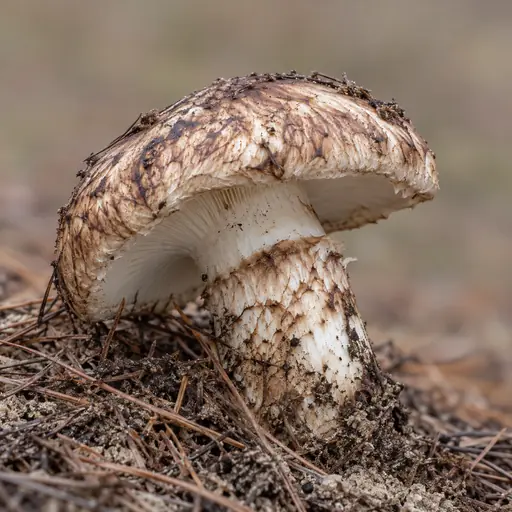
A firm white-and-brown mushroom that smells spicy, a little like cinnamon. In Japan it is prized above all others.
How to recognise it
Matsutake is a firm, heavy mushroom. The cap is 6 to 20 cm across, white with brown fibres and scales. In Europe and Asia it is browner. When young, the cap edge is rolled in. The gills are crowded, white to cream and attached to the stem. A thick white veil leaves a flaring ring. Below the ring, brown scales sheathe the stem. The solid stem narrows towards the base, with no bulb, sac or cup. The smell is strong and spicy, like cinnamon with a note of dirty socks. Without that smell it is not a matsutake. But the smell alone is no proof. Smith's amanita (Amanita smithiana) and the destroying angels are white too. These are Amanita virosa in Europe, A. bisporigera in the East and A. ocreata in the West. They have a bulb, sac or warty rings at the very base. Their ring is ragged or skirt-like and they have no spicy smell. They destroy the kidneys or liver.
Where it grows
It lives with trees on poor, well-drained soil. In Europe you find it mainly in Finland, Sweden and Norway. There it grows in dry, lichen-rich pine heaths on sand or gravel. In western North America it grows under pines, Douglas fir, hemlock, firs and tanoak, often on sandy or pumice soil. In the East, look under jack pine, red pine and eastern hemlock, in the north and the Appalachians.
When
In the Nordic countries it comes from August to October. It follows late-summer rain, once the nights turn cool. In North America the season runs from September to November. On the Pacific coast it goes on into December.
Picking
Rock it gently out of the ground. Then fill the hole and put back the moss and needles. Never rake or dig, because that damages the fungus and future crops. Matsutake is listed as Vulnerable worldwide (IUCN). It is red-listed in Sweden and Norway, where the threat is the loss of old pine forest, not picking. US national forests set their own matsutake permits and limits, so check with the ranger district.
Cooking
Wait until you have identified it with certainty. Then wipe it clean and trim the stem base, but don't wash it. Never eat it raw. Cook it gently and briefly to keep the aroma. Slice and grill it, cook it with rice or add it to a clear broth. It is firm and chewy, with a spicy, pine-like scent.
Keeping
Wrap it in paper and keep it in the fridge. Use it within a few days, before the smell fades.
Toxic look-alikes
- Amanita virosa · Deadly - do not eat
- Amanita bisporigera · Deadly - do not eat
- Amanita ocreata · Deadly - do not eat
- Amanita smithiana · Deadly - do not eat
Sources: Identification: UBC Beaty Biodiversity Museum and MushroomExpert.com. Look-alikes: North American Mycological Association poisoning reports. Status: IUCN Red List. Picking rules: US Forest Service. Season: GBIF records.
Always consult an expert before consuming any wild food. This information is for educational purposes only.