

Huckleberry
Vaccinium membranaceum
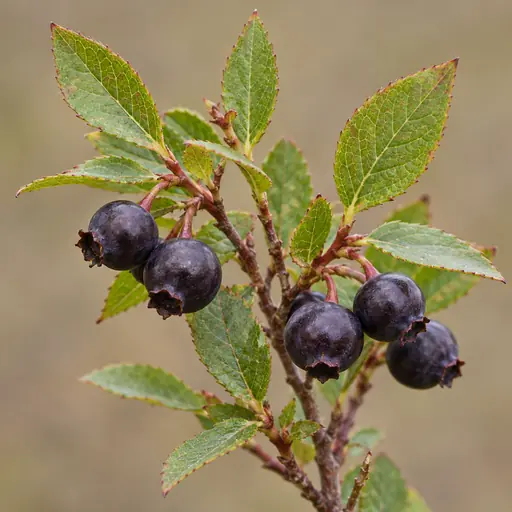
A purple-black mountain berry from the northwest of the US. It is sweeter and tarter than a blueberry.
How to recognise it
Huckleberry is a deciduous shrub, usually waist to shoulder high. Its young twigs are slightly angled and yellow-green. The leaves are thin and oval, with a pointed tip and finely toothed edges. In early summer creamy-pink, urn-shaped flowers hang singly from the leaf axils. Each gives one purple to reddish-black berry, usually without a pale bloom. At its tip sits a small ring shaped like a crown. Berries you should not eat grow in the same forests, but they grow differently. Twinberry honeysuckle (Lonicera involucrata) has black berries in pairs inside red bracts. Baneberry (Actaea rubra) is a soft herb with clustered red or white berries.
Where it grows
Look in mountain conifer forests, on open subalpine slopes and on old burns. The shrubs fruit best in sun. Its range runs from British Columbia south through the Cascades and the Northern Rockies to California. That takes in Washington, Oregon, Idaho, Montana and Wyoming. Outlying stands reach east to the Black Hills and the upper Great Lakes. In the eastern US the name huckleberry usually means Gaylussacia. That is a different shrub, whose berries hold ten small, hard seeds.
When
The berries ripen from July at lower elevations to September higher up. On each bush they ripen a few at a time. A late frost at flowering can cut the crop.
Picking
Pick by hand, berry by berry, without breaking branches. On US national forests, picking for your own use is often allowed. Sometimes you need a free permit and there are daily and season limits. Commercial picking needs a permit or is closed. Some fields are reserved for tribes, such as part of the Sawtooth Berry Fields in Washington. Check the forest's rules. Huckleberry patches are bear country, so make noise and carry bear spray.
Cooking
Once you've identified them with certainty, eat them raw or cook them. They go into pies, jam, syrup and pancakes and into sauces for game. They taste more intense than cultivated blueberries, sweet with a tart edge. Rinse them just before use.
Keeping
Unwashed and spread out, they keep a few days in the fridge. Freeze them on a tray, then bag them.
Toxic look-alikes
- Actaea rubra · Toxic - do not eat
Sources: Identification and range: USDA Forest Service (Fire Effects Information System) and University of British Columbia. Picking rules: Gifford Pinchot National Forest. Look-alikes: US National Park Service.
Always consult an expert before consuming any wild food. This information is for educational purposes only.