

Chicken of the Woods
Laetiporus sulphureus
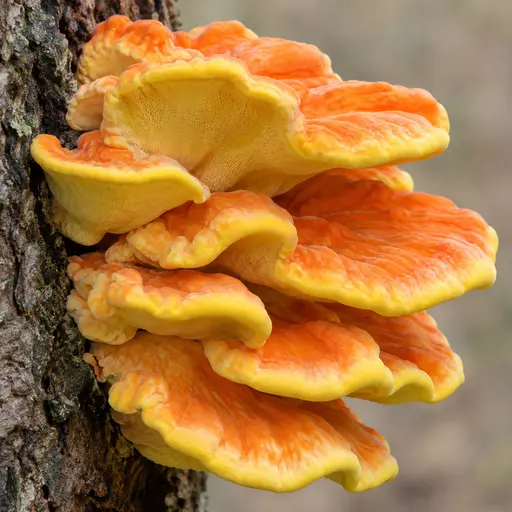
A bright orange-yellow bracket fungus that grows on trees.
How to recognise it
Chicken of the woods grows as overlapping, fan-shaped brackets 10 to 40 cm wide, with no stem. Young ones are soft, moist and bright yellow to orange. With age they fade to cream and turn chalky. The underside is sulphur-yellow with tiny pores, not gills. The flesh is white to pale yellow and does not change colour when cut. An orange cluster on wood with gills underneath is the poisonous jack-o'-lantern (Omphalotus). In the western US, the closely related Laetiporus gilbertsonii and Laetiporus conifericola look much the same.
Where it grows
This fungus rots wood. It grows on living and dead broadleaf trees, most often oak. You also see it on sweet chestnut, cherry, willow and beech (now and then on yew). It is common in lowland Europe and the eastern US, in woods, parks and streets. In the western US its relatives grow on oaks, eucalyptus and conifers.
When
It appears from late spring to autumn, mostly in summer, a few days after warm rain. In the western US it comes mainly in autumn. The same tree often fruits for several years.
Picking
Cut the soft edges of young brackets with a knife. Leave the tough base and the old, chalky brackets. Never pick it from yew, which is highly poisonous. Don't pick it from trees along busy roads either. Where mushroom picking needs a permit or has daily limits, check the local rules.
Cooking
When you're certain what it is, cook it thoroughly. Raw or undercooked, it upsets the stomach. Even well cooked, it disagrees with some people, causing nausea, dizziness and vomiting. So try a small amount first. Slice it and fry or braise it. The firm flesh is often compared to chicken. It goes well with lemon, garlic and herbs.
Keeping
It keeps a few days in the fridge in a paper bag. It freezes well, raw or cooked.
Toxic look-alikes
- Omphalotus olearius · Toxic - do not eat
- Omphalotus illudens · Toxic - do not eat
- Omphalotus olivascens · Toxic - do not eat
Sources: Identification and hosts: Woodland Trust, First Nature and MushroomExpert.com. Western species: Bay Area Mycological Society. Reactions: University of Florida IFAS Extension.
Always consult an expert before consuming any wild food. This information is for educational purposes only.