

Wild Garlic
Allium ursinum
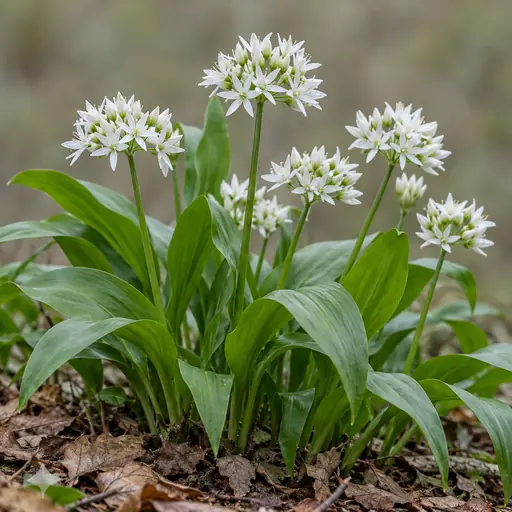
A strong-smelling wild herb with broad leaves and white flowers.
How to recognise it
Each leaf of wild garlic grows on its own thin stalk straight from the ground. The blade is soft, bright green and a pointed oval, with parallel veins. It is matt underneath. From April a leafless stalk carries a rounded cluster of white, star-shaped flowers. Crush a leaf and wild garlic smells strongly of garlic. Its deadly look-alikes do not. But the smell stays on your fingers, so after the first few leaves the test proves nothing. Check every leaf by its stalk and outline too. Lily of the valley has two or three leaves wrapped around one another at the base. Autumn crocus has tough, stalkless leaves in a tuft. Lords-and-ladies has arrow-shaped leaves with net veins. White false hellebore has pleated leaves along an upright stem. Solomon's seal has leaves alternating along an arching stem.
Where it grows
It forms carpets in damp, shady deciduous woods. It grows especially in beech woods and floodplain woods on rich soil and along shaded streams. It is common in central and northern Europe, including Britain. In southern Europe you find it mostly in mountain woods.
When
The leaves come up from February in mild places and in March and April elsewhere. They are best before the flowers open. It flowers from April to June, later in the mountains. By early summer the leaves are gone.
Picking
Pick leaf by leaf, never by the handful. That way no look-alike growing in the same patch ends up in your basket. Leave the bulbs in the ground. Britain bans digging up wild plants without the landowner's permission. Germany allows only a small amount for your own use. Many nature reserves ban picking, so check the local rules.
Cooking
Once you're certain of it, use the leaves raw or add them at the end of cooking. Put them in pesto, soups, risotto and butter, or have them with eggs. The flowers go on salads. Wash each leaf under running water. In central Europe the authorities advise this because of fox tapeworm. Its eggs survive freezing but not cooking.
Keeping
The leaves keep two or three days in the fridge in a damp cloth. Chopped leaves and pesto freeze well. Keep anything in oil in the fridge and use it within a few days.
Toxic look-alikes
- Colchicum autumnale · Deadly - do not eat
- Convallaria majalis · Deadly - do not eat
- Veratrum album · Deadly - do not eat
- Veratrum viride · Deadly - do not eat
- Veratrum californicum · Deadly - do not eat
- Arum maculatum · Toxic - do not eat
- Polygonatum multiflorum · Toxic - do not eat
Sources: Identification and look-alikes: Austrian Agency for Health and Food Safety (AGES), German Federal Institute for Risk Assessment (BfR) and Woodland Trust. Season: Woodland Trust and GBIF records.
Always consult an expert before consuming any wild food. This information is for educational purposes only.