

Pawpaw
Asimina triloba
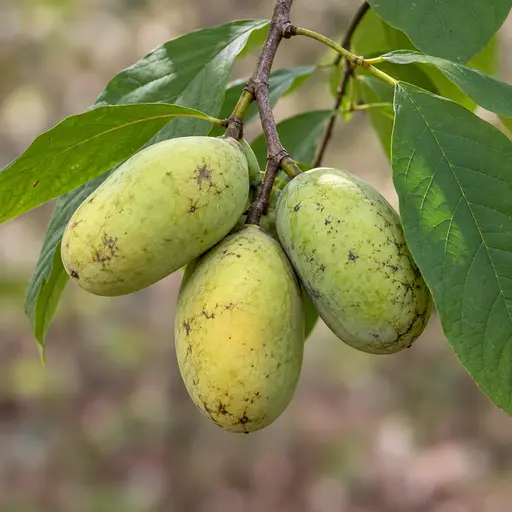
North America's biggest native fruit. It is green and shaped like a mango, with custard-soft flesh that tastes of banana and mango.
How to recognise it
Pawpaw is a small understory tree. It often forms patches from root suckers. The leaves are large and drooping and widest beyond the middle. Crushed, they smell of green pepper. In spring, deep maroon flowers with six petals open before the leaves. The fruit is oblong and green to yellow-green. It grows singly or in clusters of two to nine. Inside, soft yellow, custard-like flesh surrounds two rows of large, flat brown seeds.
Where it grows
Pawpaw grows in moist, rich woods on river floodplains, stream banks and shady lower slopes. It is native across the eastern US, from northern Florida to the Great Lakes and southern Ontario. Westwards it reaches eastern Nebraska, Kansas, Oklahoma and Texas. It does not grow wild in the western US.
When
The fruit ripens from late August in the south and in September and October in the north. A tree's crop ripens over one to two weeks. Ripe fruit drops to the ground.
Picking
A ripe fruit gives slightly when you squeeze it gently, like a peach. It also smells strongly fruity. Skin colour is not a reliable sign. Gather fresh windfalls or shake the trunk gently. In season, check every day or two. Handle the fruit carefully, as it bruises easily.
Cooking
When you're certain of the tree, eat only the flesh. Cut the fruit in half lengthwise and scoop the flesh away from the skin and seeds. Never eat or chew the skin or seeds. The flesh tastes of banana and mango. It can replace banana in breads, ice cream and puddings. Wild fruit can have a bitter aftertaste. Some people react with vomiting or an allergic reaction, so try a small amount first. Medical sources also advise against eating it in large amounts over long periods. The flesh contains annonacin, a compound that was toxic to nerve cells in laboratory studies.
Keeping
Ripe fruit lasts only a few days at room temperature and about a week in the fridge. Fruit picked just before it is fully ripe keeps up to three weeks in the fridge. Then it finishes ripening at room temperature. The scooped flesh freezes for up to a year.
Sources: Identification and range: University of Kentucky Center for Crop Diversification. Ripeness, preparation and keeping: Purdue Extension. Reactions: Memorial Sloan Kettering Cancer Center.
Always consult an expert before consuming any wild food. This information is for educational purposes only.