

Black Truffle
Tuber melanosporum
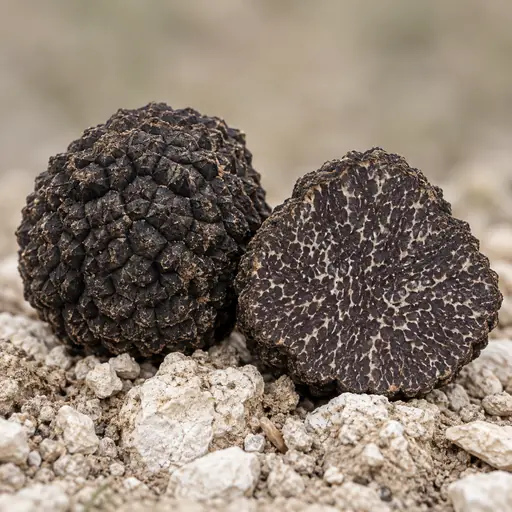
A highly prized fungus that grows underground and smells strongly. Cooks use it sparingly.
How to recognise it
This truffle is a round, lumpy tuber that grows underground. It ranges from walnut to fist size. The black skin is reddish when young and covered in small, hard, many-sided warts. Cut it in half. Ripe flesh is purplish-black, marbled with fine white veins that turn reddish-brown in the air. It smells strong and earthy. Earthballs (Scleroderma) are poisonous. They have a thick, yellowish to brown, scaly skin and smell of gas. Inside they are firm and dark. The winter truffle (Tuber brumale) and the imported Chinese truffle (Tuber indicum) look similar. But they are worth far less.
Where it grows
It grows underground among the roots of oaks (above all holm and downy oak) and of hazel. It needs well-drained, lime-rich soil in sunny hill country. A patch of bare, burnt-looking ground around a tree often shows where it grows. It is native to southern France, eastern Spain and central Italy. Much of the crop now comes from planted truffle orchards.
When
It ripens in winter, from December to March. Markets peak in January. Storms in late July and August, while it swells, decide the size of the crop.
Picking
You find it with a trained dog. Dig only where the dog marks, with a small truffle spade. Take only ripe truffles and fill the hole again. Truffle hunting is regulated. Italy requires a licence after an exam and its regions set the seasons. Spanish regions set seasons and permits. In France truffles belong to the landowner. In Germany wild truffles are protected. Check the local rules before you look.
Cooking
If you're certain of the identification, brush it clean under cold water just before use. Shave or grate it raw over warm dishes. Or warm it gently in fat, with eggs, butter, pasta, risotto or potatoes. Long cooking kills the aroma.
Keeping
Wrap it in kitchen paper in a closed jar in the fridge. Change the paper daily and use it within days, as the aroma fades. Eggs kept in the jar take on its scent. Freezing keeps the aroma better than drying.
Toxic look-alikes
- Scleroderma citrinum · Toxic - do not eat
- Scleroderma polyrhizum · Toxic - do not eat
- Scleroderma areolatum · Toxic - do not eat
- Scleroderma verrucosum · Toxic - do not eat
- Scleroderma cepa · Toxic - do not eat
Sources: Identification and habitat: CRPF Languedoc-Roussillon and Trufamania. Rules: Italian truffle law 752/1985, Spanish regional rules and German Federal Species Protection Ordinance. Season: GBIF records.
Always consult an expert before consuming any wild food. This information is for educational purposes only.