

Bronze Bolete
Boletus aereus
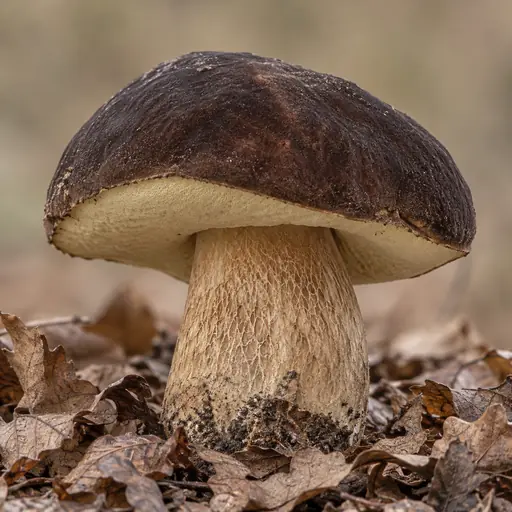
A porcino with a dark bronze to almost black cap, a pale netted stem and firm white flesh.
How to recognise it
This is the darkest porcino. The cap is dark chestnut to almost black, often with bronze patches. It stays dry and finely velvety, even when wet. The pores are white, then yellow to olive. They don't turn blue. The pale brown stem has a fine brown net, densest at the top. The very firm white flesh does not change colour when you cut it. The summer bolete is paler and its net runs further down the stem. Two other boletes share its oak woods. These are the devil's bolete (Rubroboletus satanas) and Le Gal's bolete (Rubroboletus legaliae). Both have red pores and flesh that turns blue.
Where it grows
It likes warm, sunny slopes with oak, sweet chestnut and beech, mostly between 200 and 1,000 m. It is common around the Mediterranean. In Italy you find it along the Apennines and on the islands. It is rare in Britain and Germany.
When
It can appear from July after summer storms. Its main season is September and October, later than the summer bolete. In the south it runs into November. It fruits when a soaking rain and cooling soil follow a hot spell.
Picking
Cut it or twist it out and leave the young ones to grow. In Germany it is rare and specially protected, so don't pick it there. Italy and Spain have regional permits and daily limits.
Cooking
This is the firmest of the porcini. It has a nutty taste that gets stronger when dried. Once you've identified it with certainty, treat it like porcini. Brush it, check for maggots and cook it through.
Keeping
It dries and freezes very well in slices.
Toxic look-alikes
- Rubroboletus satanas · Toxic - do not eat
- Rubroboletus rhodoxanthus · Toxic - do not eat
- Neoboletus subvelutipes · Toxic - do not eat
- Boletus sensibilis · Toxic - do not eat
- Boletus huronensis · Toxic - do not eat
- Rubroboletus pulcherrimus · Toxic - do not eat
- Rubroboletus eastwoodiae · Toxic - do not eat
- Rubroboletus legaliae · Toxic - do not eat
- Tylopilus felleus · Not edible
- Tylopilus rubrobrunneus · Not edible
- Tylopilus plumbeoviolaceus · Not edible
Sources: Identification, habitat and season: Regione Piemonte and First Nature; GBIF records. Protection: BArtSchV (Germany). Cooking: Regione Piemonte.
Always consult an expert before consuming any wild food. This information is for educational purposes only.