

Wild Blueberry
Vaccinium myrtillus
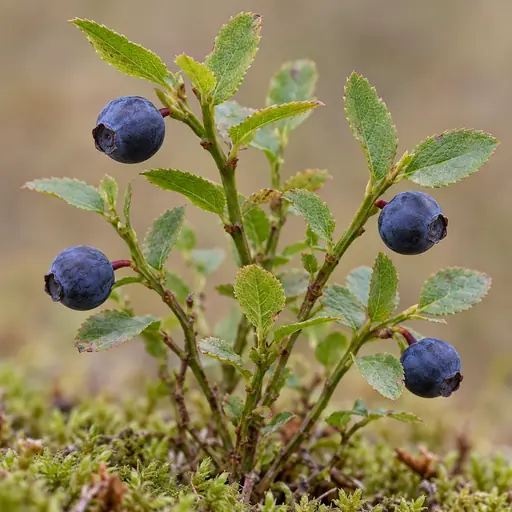
Small, sweet blue berries on low shrubs in acid soil.
How to recognise it
Bilberry, also called whortleberry, is a low deciduous shrub, usually below knee height. Its stems are green and angled. The leaves are small and oval, with finely toothed edges. In spring, pinkish flowers shaped like lanterns hang one by one. Each gives one blue-black berry with a pale bloom. At the tip of the berry sits a small ring shaped like a crown. The flesh is purple-red right through. Cultivated blueberries have pale flesh. Its poisonous look-alikes are soft herbs, not woody dwarf shrubs. Deadly nightshade (Atropa bella-donna) is tall and its shiny black berries sit in a green star of five sepals. Herb Paris (Paris quadrifolia) carries one berry on top of a stem with a whorl of four leaves. Solomon's seal (Polygonatum) hangs blue-black berries beneath an arching, unbranched stem.
Where it grows
It needs acid, nutrient-poor soil. Look in conifer, birch and oak woods and on heaths and moorland, from the lowlands to above the treeline. It is common across northern and central Europe and in the mountains of the south. You won't find it on lime. In North America it grows wild in the western mountains. In the east, the wild blueberries people pick are lowbush and highbush blueberries (Vaccinium angustifolium, Vaccinium corymbosum). These are close relatives with pale flesh.
When
In the lowlands the berries ripen from July. In the mountains and the north the season runs through August into September. A late frost at flowering can cut the crop.
Picking
Pick by hand. Berry combs strip leaves and damage the plants. Some places ban them or set daily limits, such as the Vosges in France and Tuscany in Italy, so check the local rules. In central Europe, Bavaria's health authority (LGL) says eating wild berries has not been shown to be a risk factor for fox tapeworm. It still advises washing them well. Only heating above 60 °C kills its eggs and home freezing does not.
Cooking
When you're sure of the plant, eat them raw or put them in tarts, pancakes, jam and compote. They are sweet and sharp. They also stain fingers, teeth and clothes. Rinse them briefly just before use and pick out leaves and green berries.
Keeping
Unwashed and spread out, they keep a few days in the fridge. Freeze them on a tray, then bag them. They also dry well.
Toxic look-alikes
- Atropa bella-donna · Deadly - do not eat
- Paris quadrifolia · Toxic - do not eat
- Polygonatum multiflorum · Toxic - do not eat
Sources: Identification and habitat: Woodland Trust; look-alikes: Yle (Finnish public broadcaster). Picking rules: Vosges prefecture and Region of Tuscany. Fox tapeworm: Bavarian State Office for Health and Food Safety (LGL).
Always consult an expert before consuming any wild food. This information is for educational purposes only.