

Masterwort
Peucedanum ostruthium
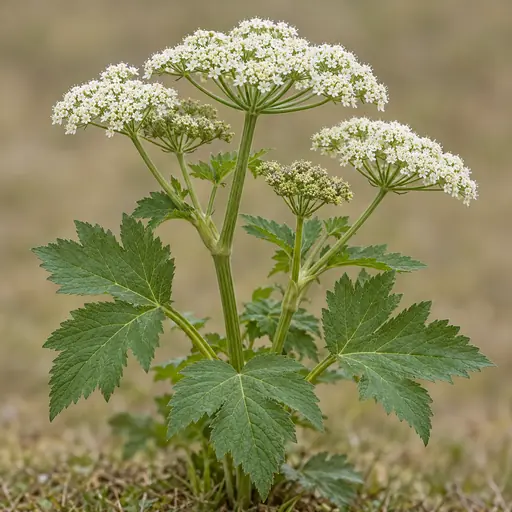
A perennial herb with aromatic leaves and white flower clusters. It has long been used as a spice and in folk medicine.
How to recognise it
Masterwort is a hairless umbellifer 30 to 100 cm tall. Its stem is round, grooved and hollow. The leaves split into three and then into three again. They end in broad, oval, double-toothed leaflets 5 to 10 cm long. The upper leaves sit on large, inflated sheaths. The umbels are flat and white or pinkish, with up to 50 rays. The fruits are round, flat and broadly winged. A crushed leaf or the thick brown rootstock smells strongly spicy, of celery and carrot. Its deadly look-alikes have finely divided leaves, feathery or like a fern's. Hemlock has a smooth, purple-blotched stem and a mousy smell. Fool's parsley has long bracts hanging under each small umbel. Cowbane (water hemlock) has a rootstock split into hollow chambers when you cut it lengthways. Hemlock water dropwort has pale tubers in wet ground. Giant hogweed is far bigger, with a bristly, purple-blotched stem. Its sap burns skin in sunlight. Masterwort's own sap can also make skin sensitive to sunlight.
Where it grows
It grows in damp mountain meadows and tall-herb stands, on stream banks and scree and in alder scrub. Mostly you find it between 1,400 and 2,700 m. It grows in the Alps, the Pyrenees, the Carpathians and other mountains of central and southern Europe. In Germany it is native only in the Bavarian Alps. Lower down it is rare and usually escaped from old gardens, as in Britain and Scandinavia.
When
The leaves grow as the snow melts. They are best young, in early summer. It flowers from late June to August and the fruits ripen in September and October.
Picking
Wear gloves. Take a few leaves from a large stand and leave the rootstock in the ground. Digging the root often needs a permit. In Tyrol that comes from the district authority. Many reserves and national parks ban picking. It grows among monkshood and white false hellebore. Both are deadly. Pick leaf by leaf and only from a plant you have identified as a whole.
Cooking
Be certain of your identification first. Use it as a seasoning, not a vegetable, because it is strongly bitter and spicy, like lovage. In the Alps the root flavours schnapps (Meisterwurzbrand) and herb cheese. Chop a few young leaves finely and add them sparingly to soups and fresh cheese. Wash your hands after handling it.
Keeping
Dry the leaves or slices of root in an airy, shaded place. Then store them in a closed jar.
Toxic look-alikes
- Conium maculatum · Deadly - do not eat
- Aethusa cynapium · Deadly - do not eat
- Cicuta virosa · Deadly - do not eat
- Oenanthe crocata · Deadly - do not eat
- Heracleum mantegazzianum · Toxic - do not eat
Sources: Identification, habitat and season: Botanical Society of Britain and Ireland and Alpine floras. Root digging and schnapps: Austrian Ministry of Agriculture (register of traditional foods). Skin reactions: Botanical Dermatology Database.
Always consult an expert before consuming any wild food. This information is for educational purposes only.