

Walnut
Juglans regia
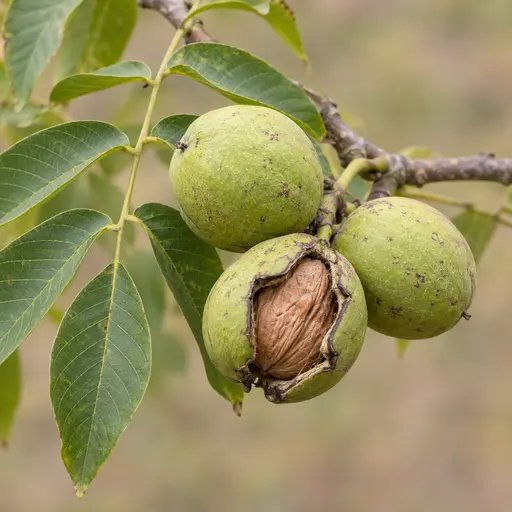
Big round nuts with hard shells and a rich, oily taste.
How to recognise it
The walnut is a large tree. Its bark is smooth and olive-brown, turning grey and fissured with age. The leaves have five to nine smooth-edged oval leaflets. Crushed, they smell of polish. The nut sits in a thick, smooth green husk that darkens and splits when ripe. The black walnut of the eastern US has more leaflets and they are narrower and toothed. Its round husk does not split. Inside is a very hard, ridged shell.
Where it grows
Walnut is native from south-east Europe to south-west China. It has been planted across Europe and gone wild in hedgerows, field edges, riverbanks and young woods. It grows mostly at low altitude on deep, fertile soil. In the US, orchards are mainly in California. In the eastern woods the wild species is the black walnut.
When
Walnuts come in September and October, when the husks crack and the nuts drop. Green walnuts for pickling or liqueur are picked in late June or early July. At that stage a skewer still goes straight through them.
Picking
Gather fallen nuts every day or two, before mould and insects spoil them. Wear gloves, because the husk stains skin brown for days. Remove the husks soon. Most walnut trees belong to someone, so ask first.
Cooking
Once you are sure of the tree, eat fresh walnuts with the bitter skin peeled off. Or dry them for bread, cakes, salads and sauces. Throw away mouldy, shrivelled or rancid kernels. Walnuts are a common cause of nut allergy.
Keeping
Dry them in the shell in an airy, shady place, until the divider between the halves snaps. Dried nuts keep up to a year in the fridge.
Sources: Identification and range: Woodland Trust. Harvest and storage: Oregon State University and Kansas State University extension.
Always consult an expert before consuming any wild food. This information is for educational purposes only.