

Golden Chanterelle
Cantharellus cibarius
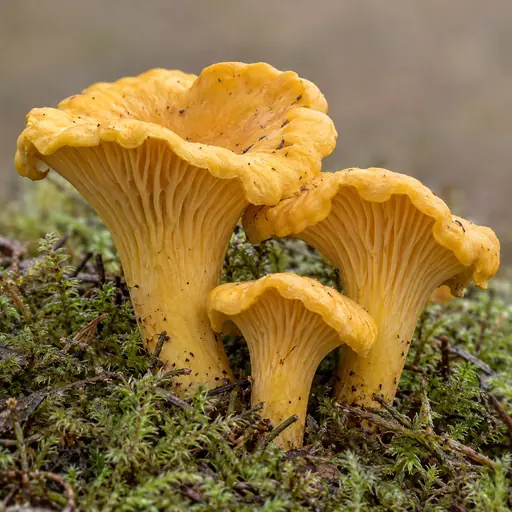
A golden yellow mushroom shaped like a funnel. It smells fruity, a little like apricots.
How to recognise it
Chanterelles are egg-yolk to golden yellow and grow up to 10 cm across. The cap is a shallow funnel with a wavy edge that curls under. Underneath you won't find real gills, but blunt, forking ridges that run down the stem. You can't lift them off one by one like gills. The stem is solid and the flesh is firm and white to pale yellow. It smells faintly of apricots. Two look-alikes matter. Jack-o'-lanterns (Omphalotus) have thin, crowded real gills, grow in clusters from wood or buried roots and are orange right through. The false chanterelle (Hygrophoropsis aurantiaca) is a deeper orange and soft. It also has thin, crowded gills.
Where it grows
Chanterelles live with tree roots. They grow under oak, beech, birch, chestnut, spruce and pine, mostly on acid soil in moss. You often find them on banks and beside paths. They are common across Europe, from the lowlands to the mountains. In North America the golden chanterelle is really several close species. Examples are Cantharellus flavus in the East, C. californicus under live oaks in California and C. cascadensis in the Pacific Northwest.
When
In central and northern Europe they come from late June to October, after warm, soaking rain. In southern Europe the season starts later and lasts longer, into winter in Mediterranean oak woods. In the eastern US they fruit in summer after warm rain. In the West they follow the autumn rains and in California they run on into winter.
Picking
Cut or twist them at the base and brush off the soil on the spot. Leave the small ones to grow. In Germany they are specially protected. There you may pick only small amounts, for your own use. Swiss cantons, Italian regions, parts of France and Spain and US public lands set their own limits or permits. Check the local rules.
Cooking
Once you're certain of them, brush chanterelles clean rather than washing them. They soak up water. Never eat them raw. Cook them well, first in a dry pan until the water has gone, then in butter. They taste mild, fruity and slightly peppery, with a firm bite. They are good with eggs, cream, potatoes, pasta and chicken.
Keeping
They keep a few days in the fridge in paper, not plastic. Dried chanterelles turn tough. For longer keeping, fry them in butter and freeze them.
Toxic look-alikes
- Omphalotus olearius · Toxic - do not eat
- Omphalotus illudens · Toxic - do not eat
- Omphalotus olivascens · Toxic - do not eat
- Omphalotus subilludens · Toxic - do not eat
- Turbinellus floccosus · Toxic - do not eat
- Hygrophoropsis aurantiaca · Not edible
Sources: Identification and habitat: First Nature (UK) and MushroomExpert.com. North American species and look-alikes: University of Florida IFAS Extension. Protection: German Federal Species Protection Ordinance. Season: GBIF records.
Always consult an expert before consuming any wild food. This information is for educational purposes only.