

Parasol Mushroom
Macrolepiota procera
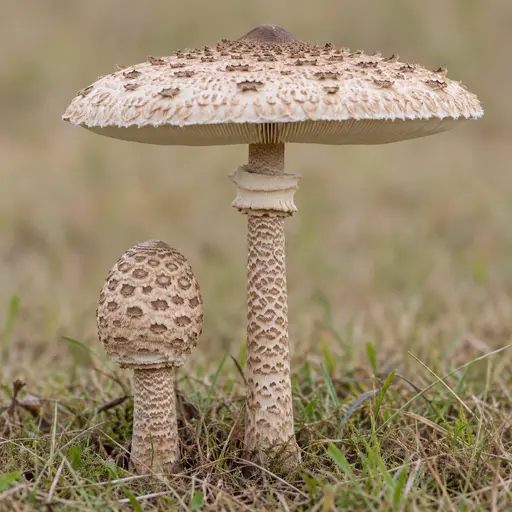
A big, tall mushroom with a broad, scaly cap that opens like a parasol. Eat it young.
How to recognise it
The parasol is a tall mushroom. Its cap starts as a closed, egg-shaped drumstick. It opens into a flat umbrella 10 to 25 cm across. The cap is cream with brown scales and a smooth brown bump in the centre. The gills are white, free and crowded. The slender stem grows up to 30 cm tall and has a bulb at the base. It has a brown snakeskin pattern and a thick double ring that slides up and down. The spore print is white. Several look-alikes matter. The deadly Lepiota species are small, with caps of only a few centimetres. Chlorophyllum molybdites gives a greenish spore print. The shaggy parasols (Chlorophyllum rhacodes and C. brunneum) upset many people. They have a smooth stem and their flesh turns orange-red when cut. Amanita pantherina has white warts on the cap and a ring that does not slide. It also has a rimmed bulb at the base.
Where it grows
It grows in grassland and at woodland edges. Look in pastures, meadows, clearings, rides and dunes. It likes well-drained soil, from the lowlands to the mountains. It is common across Europe.
When
Parasols come in summer and autumn, mainly from July to October. In southern Europe they go on into November. They come up after a spell of warm, wet weather.
Picking
Pick only open, full-size caps where you can check every feature. Lift the whole mushroom so you can see the base. Leave any parasol-like mushroom with a cap under 10 cm. Leave old, tough ones too. Check the local rules, because many regions limit how much you may pick.
Cooking
Once you're certain of it, eat only the cap and cook it. Like most wild mushrooms, it can upset the stomach raw. Bread it and fry it like a schnitzel, or grill it with butter and garlic. It tastes mild and nutty. You can dry the tough stems and grind them for soups.
Keeping
It keeps two days in the fridge. Sliced caps dry well.
Toxic look-alikes
- Lepiota brunneoincarnata · Deadly - do not eat
- Lepiota cristata · Deadly - do not eat
- Lepiota subincarnata · Deadly - do not eat
- Chlorophyllum molybdites · Toxic - do not eat
- Amanita pantherina · Toxic - do not eat
- Chlorophyllum brunneum · Toxic - do not eat
Sources: Identification and habitat: First Nature. Look-alikes and poisonings: ANSES. Season: GBIF records.
Always consult an expert before consuming any wild food. This information is for educational purposes only.