

Elderberry
Sambucus nigra
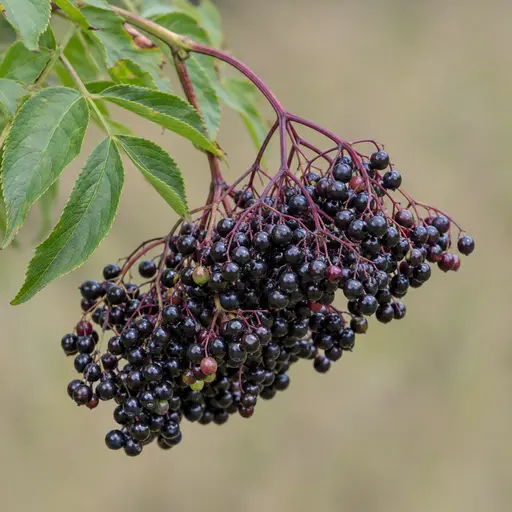
Small, dark purple berries that hang in clusters on elder trees.
How to recognise it
Elder is a shrub or small tree with grey-brown, corky, furrowed bark. The twigs have soft white pith inside. The leaves are opposite, with five to seven toothed leaflets. American elderberry can have up to eleven. In early summer it carries flat heads of creamy, scented flowers. These become broad clusters of small purple-black berries on reddish stalks. When ripe, the clusters droop under their weight. Dwarf elder (Sambucus ebulus) is a soft herb that dies back each winter. Its berry clusters stand upright above the leaves. Red elder (Sambucus racemosa) has red berries in upright, dome-shaped clusters. Pokeweed (Phytolacca americana) is a tall herb with smooth purple-red stems. Its berries are strung along long spikes, not held in flat clusters.
Where it grows
Look in hedgerows, at woodland edges, in scrub, on riverbanks, on wasteland and at the edges of villages. It likes rich, moist soil and grows across Europe except the far north. In the eastern US the native American elderberry grows along streams, wet ditches and field edges. In the west you find blue elderberry on open slopes and in valleys. Its ripe berries carry a dusty blue bloom.
When
The berries ripen in early autumn. In warm lowlands they start in late August. Further north and in the mountains they run through September into October. The creamy flower heads come earlier, from late May.
Picking
Cut whole clusters with scissors when every berry is purple-black. Leave clusters that still have green or red berries. Avoid busy roadsides and leave plenty on each bush for the birds.
Cooking
Elderberries must be cooked. Raw or unripe berries, stems, leaves and seeds contain compounds that release cyanide during digestion. They can cause nausea, vomiting and stomach cramps. Thorough cooking breaks them down. Once you've identified them with certainty, strip the berries from the stalks with a fork. Throw away green berries and every bit of stem. Simmer them into syrup, jelly, juice, soup or pie filling. The taste is dark, earthy and tart. It goes well with apple, pear, cinnamon and lemon. Never use red elderberries for food.
Keeping
Fresh clusters keep a day or two in the fridge. If you freeze them whole, the berries shake off the stalks easily. Frozen or dried berries must still be cooked before you eat them.
Toxic look-alikes
- Sambucus ebulus · Toxic - do not eat
- Phytolacca americana · Toxic - do not eat
- Sambucus racemosa · Toxic - do not eat
Sources: Identification and habitat: Woodland Trust. Toxicity, cooking and keeping: Oregon State University Extension.
Always consult an expert before consuming any wild food. This information is for educational purposes only.