

Pine Bolete
Boletus pinophilus
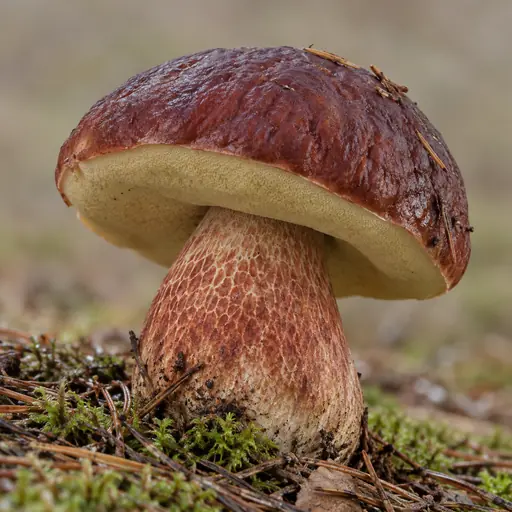
A porcino of pine woods with a red-brown cap, a stout reddish netted stem and firm flesh.
How to recognise it
This is the red porcino. The cap is wine-red to mahogany and often bumpy. It is velvety when young and greasy to slimy when wet, with a whitish bloom at the edge. The stem is short and stout, flushed reddish brown, with a fine whitish to reddish net. The flesh is white, but wine-red just under the cap skin. The pores go from white to yellow and olive. They barely change colour when you press them. The bronze bolete is sepia to black, with no red. Red or orange pores (Rubroboletus satanas) rule it out. So do pink pores with a dark net (Tylopilus felleus).
Where it grows
It grows mostly with Scots pine and spruce on acid ground, often in moss. In the mountains it also grows with chestnut, beech and fir, mainly at 400 to 1,400 m. It is common in Scandinavia, in Scotland's pinewoods and in the mountains of central and southern Europe.
When
It is often the first porcino of the year and the last. A first flush comes in May and June where it stays cool and moist. The main crop follows in September and October. It goes on into November, past the first frosts.
Picking
Cut or twist it out and don't rake the moss, which shelters the fungus. Many Italian and Spanish regions require a permit. Some Swiss cantons limit amounts. Check the local rules.
Cooking
If you've identified it with certainty, cook it through like porcini. It is milder and slightly resinous. Very firm young ones need longer cooking. It tints the cooking water green. It suits sauces, pickling and drying.
Keeping
It dries well in slices. Fresh, use it within a day or two.
Toxic look-alikes
- Rubroboletus satanas · Toxic - do not eat
- Rubroboletus rhodoxanthus · Toxic - do not eat
- Neoboletus subvelutipes · Toxic - do not eat
- Boletus sensibilis · Toxic - do not eat
- Boletus huronensis · Toxic - do not eat
- Rubroboletus pulcherrimus · Toxic - do not eat
- Rubroboletus eastwoodiae · Toxic - do not eat
- Rubroboletus legaliae · Toxic - do not eat
- Tylopilus felleus · Not edible
- Tylopilus rubrobrunneus · Not edible
- Tylopilus plumbeoviolaceus · Not edible
Sources: Identification, habitat and season: Regione Piemonte and First Nature; GBIF records. Cooking: Regione Piemonte.
Always consult an expert before consuming any wild food. This information is for educational purposes only.