

Summer Bolete
Boletus reticulatus
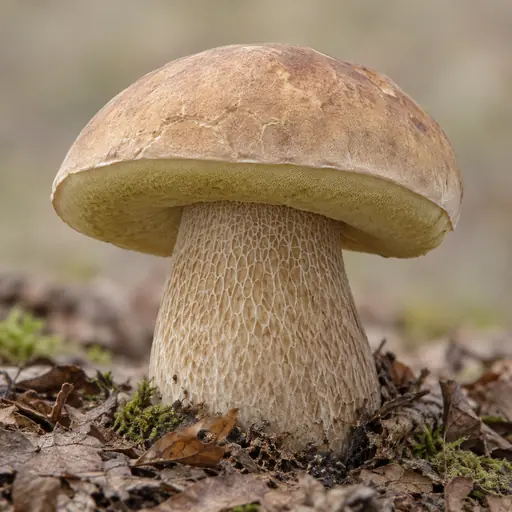
The earliest porcino. Its pale brown cap is finely cracked and its stem is netted from top to bottom.
How to recognise it
The summer porcino has a matt, dry, velvety cap, pale hazel to mid-brown. In dry weather the cap cracks into a fine network. It is never greasy and its edge is no paler than the centre. Its clearest mark is a raised net that runs down the stem almost to the base. The pores are white, then yellow-olive. They do not change colour. The white flesh is softer than in porcini. The devil's bolete (Rubroboletus satanas) and Le Gal's bolete (Rubroboletus legaliae) share its oak woods. But they have red pores and flesh that turns blue. The bitter bolete (Tylopilus felleus) has pink pores and a dark net.
Where it grows
It grows with oak and sweet chestnut and also with beech, lime and birch. Look at wood edges, in parks and on sunny slopes, from the lowlands to about 1,000 m. It is common in central and southern Europe, especially in south-west France and Portugal. In Britain it is rare.
When
This is the first porcino of the year. It starts in May on low ground and in June in the mountains. The main season is July to early September, after warm rain. It lasts until the first autumn cold.
Picking
Cut or twist it out and leave the small ones. In hot weather many are maggoty. Halve them on the spot and leave infested ones in the wood. Many Italian and Spanish regions require a permit.
Cooking
Many cooks rate it the finest porcino. It is sweet, nutty and fragrant. It is good for drying, sauces and egg dishes. Once you've identified it with certainty, cut away maggoty parts and cook it through.
Keeping
Of all the porcini, it keeps worst. Cook or dry it the day you pick it.
Toxic look-alikes
- Rubroboletus satanas · Toxic - do not eat
- Rubroboletus rhodoxanthus · Toxic - do not eat
- Neoboletus subvelutipes · Toxic - do not eat
- Boletus sensibilis · Toxic - do not eat
- Boletus huronensis · Toxic - do not eat
- Rubroboletus pulcherrimus · Toxic - do not eat
- Rubroboletus eastwoodiae · Toxic - do not eat
- Rubroboletus legaliae · Toxic - do not eat
- Tylopilus felleus · Not edible
- Tylopilus rubrobrunneus · Not edible
- Tylopilus plumbeoviolaceus · Not edible
Sources: Identification, habitat and season: Regione Piemonte and First Nature; GBIF records. Cooking: Regione Piemonte.
Always consult an expert before consuming any wild food. This information is for educational purposes only.