

Blackberry
Rubus fruticosus
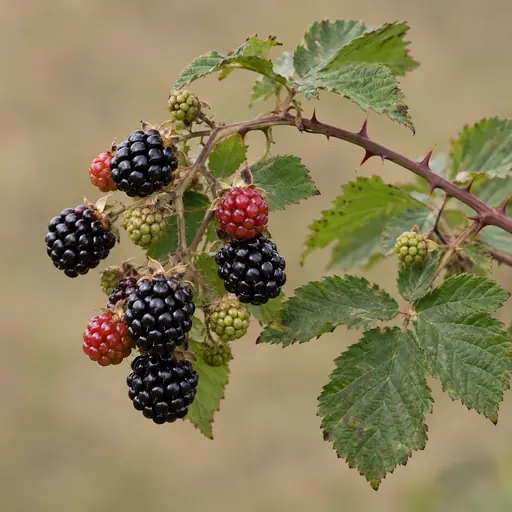
Sweet, dark purple berries on thorny bushes.
How to recognise it
Brambles have long, arching stems armed with hooked prickles. Each leaf has three or five toothed leaflets spread like a hand. They are dark green on top and paler underneath. The flowers are white or pink, with five petals. The berries are made of many small round drupelets. They go from green to red to glossy black. A ripe blackberry comes off with its white core inside. A raspberry leaves its core on the plant and is hollow. Rubus fruticosus is a group of hundreds of closely related brambles. You use them all the same way.
Where it grows
Look in hedgerows, at woodland edges and in clearings, scrub, wasteland and railway banks. It grows on almost any soil, across Europe except the far north. In the US, native blackberries grow in old fields and at woodland edges. The introduced Himalayan blackberry forms dense thickets in the Pacific Northwest and California.
When
In the south of Europe and in the US the berries ripen from July. Further north they start in late July or August. They keep coming until the first frosts in September and October. Flowers, green fruit and ripe fruit often hang on the same bush.
Picking
Pick only fully black berries that come away with a gentle pull. Leave the red ones and leave some for wildlife. Avoid busy roadsides and edges sprayed with weedkiller. In central Europe there is fox tapeworm to think about. Bavaria's health authority (LGL) says eating wild berries has not been shown to be a risk factor for it. It still advises washing them well. Only heating above 60 °C kills its eggs and home freezing does not.
Cooking
Once you're certain of the plant, you can eat the berries raw or cooked. Bake them in crumbles and pies with apple, or make jam, jelly, syrup and vinegar. Rinse them just before you use them and check for insects. The flavour ranges from sweet to sharp, from one bush to the next.
Keeping
Unwashed and spread out in a shallow box, they keep a day or two in the fridge. To freeze them, spread them on a tray and bag them once they are hard. Frozen berries suit cooking.
Sources: Identification, habitat and uses: Woodland Trust. Fox tapeworm: Bavarian State Office for Health and Food Safety (LGL).
Always consult an expert before consuming any wild food. This information is for educational purposes only.