

Lion's Mane
Hericium erinaceus
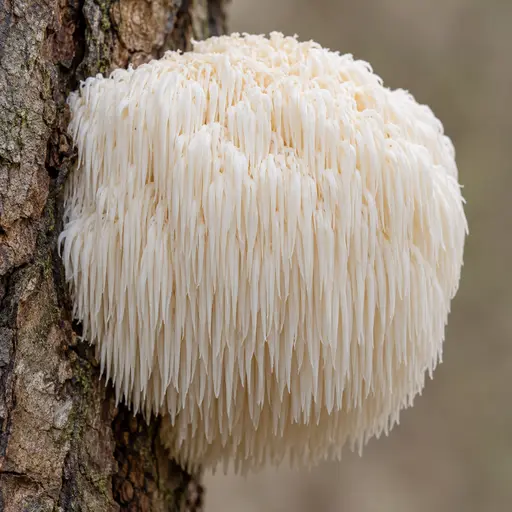
A white, shaggy clump of long hanging spines on hardwood trees. Cooked, it tastes a bit like crab.
How to recognise it
Lion's mane is a single white, rounded clump 8 to 24 cm across. It has no cap or gills. Soft spines 1 to 5 cm long hang from it like icicles. It turns yellow with age. The flesh is white and soft and does not change colour when cut. The spore print is white. Its relatives coral tooth (Hericium coralloides) and bear's head (Hericium americanum) are branched and have shorter spines.
Where it grows
It grows from wounds in living broadleaf trees and on dead trunks. Most often that is oak, but also beech and maple. It often grows high up. You find it across the US, more in the East. In Europe it is rare, on old beech and oak in ancient woods.
When
Look from late summer to late autumn, after rain. In warm areas such as California it carries on through winter. It often returns to the same tree.
Picking
In Europe, leave it. It is rare and protected by law in several countries, including the UK, Poland, Hungary, Croatia, Slovenia and Sweden. Photograph it and report the find. In the US, cut fresh white clumps at the base with a knife. National forests and parks may need a permit or ban collecting, so check the local rules.
Cooking
Once you're certain of it, cook it. Slice it and dry-fry it to drive off the water. Then brown it in butter. The mild, sweet taste and stringy texture are often compared to crab. Yellowed clumps taste sour.
Keeping
It keeps a few days in the fridge in a paper bag. Freeze it after cooking.
Sources: Identification and season: MushroomExpert.com and Wild Food UK. Protection: IUCN Red List and the UK Wildlife and Countryside Act 1981.
Always consult an expert before consuming any wild food. This information is for educational purposes only.