

Black Trumpet (Horn of Plenty)
Craterellus cornucopioides
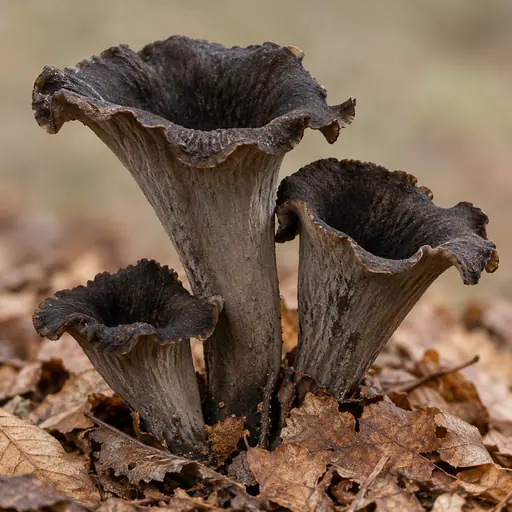
A dark, funnel-shaped mushroom with a rich, smoky taste. Cooks prize it.
How to recognise it
You're looking for a thin, hollow horn 4 to 8 cm across. It is open right down to the base and has no separate cap. The inside is grey-brown to black and finely scaly. The outside is ash-grey and smooth or only faintly wrinkled, with no gills or ridges. As it ripens it turns paler, with a whitish bloom. The flesh is thin, brittle and grey-black, with a faint, sweet smell. Black trumpets of the eastern US (Craterellus fallax) look the same. They give a pinkish-orange spore print rather than a white one. The ash-grey chanterelle (Craterellus cinereus) has clear forked ridges on the outside.
Where it grows
It lives with broadleaf trees: mainly beech and oak, also hornbeam and hazel. Look in damp leaf litter and moss, on rich, loamy soil, in gullies and on banks. It often grows in large groups. It is common across Europe. In the eastern US its counterpart grows under oak and beech. On the Pacific coast a western black trumpet grows under tanoak, live oak and madrone.
When
It is mainly an autumn mushroom. In Europe it runs from late summer to November, into December in mild years and later still around the Mediterranean. In the eastern US it comes from July to October, after heavy rain. On the Pacific coast the western black trumpet fruits from midwinter into spring.
Picking
Pinch or cut it at the base. Leave the small ones and take only what you will eat. Local limits on wild mushrooms apply. It hides well in dark litter, so where you find one, look closely around it.
Cooking
Be sure of what you've found before it goes in the pan. Split each trumpet lengthwise and rinse out leaves, insects and grit. Then drain it well. Never eat it raw. Cook it well, in butter, cream sauces, risotto or pasta, or with fish and eggs. The taste is deep and smoky and it gets stronger after drying.
Keeping
Fresh, it lasts only a few days in the fridge. It dries quickly and very well. Keep it in a closed jar, or grind it to a powder for sauces and soups.
Sources: Identification and habitat: First Nature (UK), MushroomExpert.com and MykoWeb (California Fungi). Season: GBIF records.
Always consult an expert before consuming any wild food. This information is for educational purposes only.