

Rocky Mountain King
Boletus rubriceps
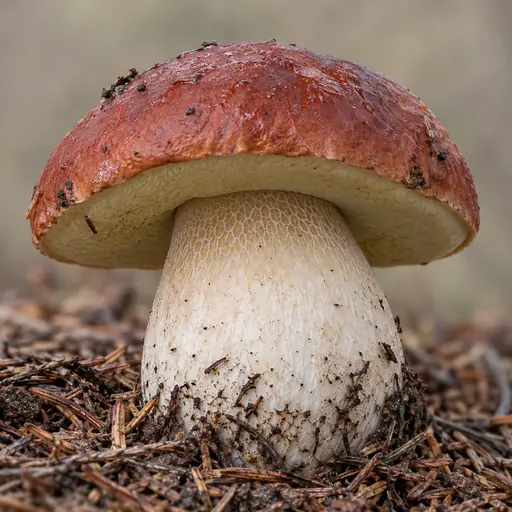
A stout porcino of the high mountains. It has a brick-red to red-brown cap, white pores and a thick pale stem with a net at the top.
How to recognise it
This is a big, stout porcino of the high Rockies. The cap is brick-red to reddish-brown and tacky when fresh. Young caps often have a whitish bloom. It is redder than the porcini (Boletus edulis) that also grow there. The pores are white and stuffed when young, then turn yellow and olive. They do not bruise. The thick, pale stem has a fine white net, at least near the top. The white flesh does not turn blue. Aspen boletes (Leccinum) have dark scales on the stem. Orange-capped ones have caused severe stomach poisonings in Colorado. Red or orange pores mean a toxic bolete.
Where it grows
It grows mainly with Engelmann spruce and also with fir and Douglas fir. You find it from about 2,400 m up to the tree line. It grows in Colorado, New Mexico and the mountains of Arizona.
When
It fruits from July to September, sometimes into October. It starts with the monsoon storms and moves upslope through the season. In dry summers it barely fruits.
Picking
Twist it out gently, since much of the stem is underground. Leave very maggoty ones. Each national forest sets its own rules. Some ask for a free permit and set daily limits.
Cooking
Be certain of the identification first. On mature caps, remove the yellow, soft pores. They can taste bitter and turn slimy. Then cook it through like porcini, or dry it.
Keeping
Dry it in thin slices, or sauté it and freeze it.
Toxic look-alikes
- Rubroboletus satanas · Toxic - do not eat
- Rubroboletus rhodoxanthus · Toxic - do not eat
- Neoboletus subvelutipes · Toxic - do not eat
- Boletus sensibilis · Toxic - do not eat
- Boletus huronensis · Toxic - do not eat
- Rubroboletus pulcherrimus · Toxic - do not eat
- Rubroboletus eastwoodiae · Toxic - do not eat
- Rubroboletus legaliae · Toxic - do not eat
- Leccinum insigne · Toxic - do not eat
- Tylopilus felleus · Not edible
- Tylopilus rubrobrunneus · Not edible
- Tylopilus plumbeoviolaceus · Not edible
Sources: Identification and habitat: Arora and Frank (2014), MushroomExpert and Forage Colorado. Season: GBIF records. Rules: US Forest Service.
Always consult an expert before consuming any wild food. This information is for educational purposes only.