

Pacific Chanterelle
Cantharellus formosus
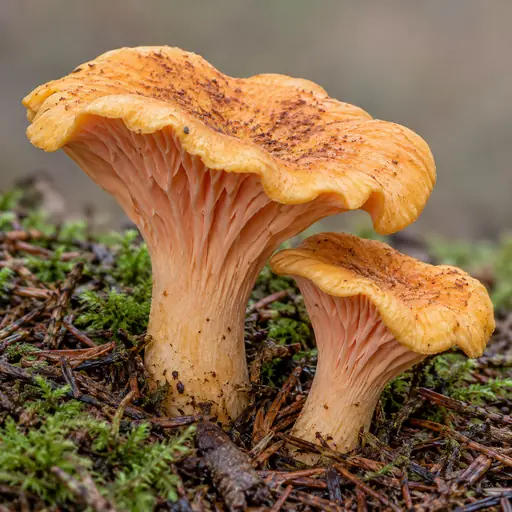
A big golden chanterelle from the Pacific Northwest. It is paler and pinker than the European one.
How to recognise it
This is a large chanterelle, paler and pinker than the European one. The cap is orange-yellow to apricot. Young caps often have fine brownish scales and a pinkish cast, which can vanish in wet weather. Underneath are blunt, forking ridges that run down the stem. They are pale orange-yellow and usually tinged pink. The stem tapers downward and the flesh is whitish and firm. The cap bruises yellowish. Jack-o'-lanterns (Omphalotus) and the false chanterelle have thin, crowded true gills. The scaly vase chanterelle (Turbinellus floccosus) is a deep, hollow, orange-red trumpet with coarse scales. It upsets many people's stomachs.
Where it grows
It lives with conifers: mainly Douglas fir and western hemlock, also Sitka spruce. Look in moss and needle litter, in second-growth and old forest. It grows mostly in the lowlands and foothills. Its range runs from British Columbia through Washington and Oregon to northern California. In Oregon it is the state mushroom.
When
You find it from September to December, sometimes into January. It needs the autumn rains to soak the ground first, so a dry autumn delays it. Each mushroom grows slowly. In cool, wet weather it can keep growing for weeks.
Picking
Cut it at the base and leave the small buttons to grow on. Take only what you will eat. Rules differ by national forest, state and park. Some require a free permit and set daily limits. Many state parks forbid picking. Selling needs a commercial permit. Check with the land manager.
Cooking
When you're certain what it is, brush off the needles and soil. Rinse it only if it's gritty, then dry it, because rain-soaked ones hold water. Never eat it raw. Dry-fry it first to drive off the water, then finish it in butter. It is mild, fruity and firm. It's good with eggs, cream, pasta, salmon and game.
Keeping
It keeps several days in the fridge in a paper bag. Dried, it turns tough. To keep it longer, fry it in butter and freeze it.
Toxic look-alikes
- Omphalotus olearius · Toxic - do not eat
- Omphalotus illudens · Toxic - do not eat
- Omphalotus olivascens · Toxic - do not eat
- Omphalotus subilludens · Toxic - do not eat
- Turbinellus floccosus · Toxic - do not eat
- Hygrophoropsis aurantiaca · Not edible
Sources: Identification: MushroomExpert.com and UBC Beaty Biodiversity Museum. Picking rules: US Forest Service. Season: GBIF records.
Always consult an expert before consuming any wild food. This information is for educational purposes only.