

St. George's Mushroom
Calocybe gambosa
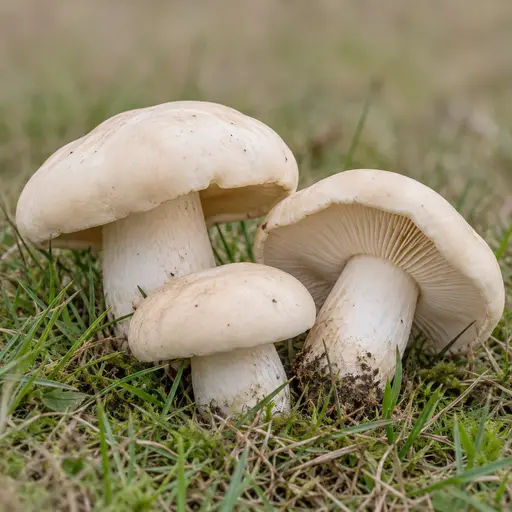
A firm white mushroom that smells of fresh flour. It appears in spring, around St George's Day.
How to recognise it
St George's mushroom is stout and fleshy, white to cream. The cap is 5 to 15 cm across, often lumpy, with an inrolled edge. The gills are white, narrow and very crowded. The thick, solid stem has no ring and no sac at the base. The firm white flesh does not change colour. It smells strongly of fresh meal. The spore print is white. The deadly Inosperma erubescens has a pointed, streaky cap. It reddens where handled and gives a brown spore print. Entoloma sinuatum can smell mealy too. But its gills turn pink and its spore print is pink. White Amanitas such as the deadly Amanita verna are also out in spring. They have a ring and a sac at the base.
Where it grows
It grows in grass, in pastures, mown verges, parks and woodland edges. You often find it by hawthorn, blackthorn and other hedgerow shrubs, mostly on lime-rich ground. It comes back to the same spots for years, often in rings. It grows across Europe and is much sought after in northern Spain and central Italy.
When
It comes in spring, mainly in April and May. In the north and in the mountains it lasts into June. It is named after St George's Day, 23 April. A mild, wet spring brings it on.
Picking
Cut the stem at the base and leave the small ones. Take young, firm caps, as older ones are often full of maggots. Avoid busy verges. Check the local rules too, because some regions require a permit or set a daily limit.
Cooking
Once you're sure of it, eat it cooked. Cooking takes away most of the mealy smell. The firm, mild flesh suits omelettes, scrambled eggs, risotto and cream sauces. Cut each one lengthways first to check for maggots.
Keeping
It keeps up to two days in the fridge, wrapped in paper. It freezes well after a quick sauté.
Toxic look-alikes
- Inosperma erubescens · Deadly - do not eat
- Amanita verna · Deadly - do not eat
- Entoloma sinuatum · Toxic - do not eat
Sources: Identification and habitat: First Nature. Look-alikes: First Nature and ANSES. Season: GBIF records.
Always consult an expert before consuming any wild food. This information is for educational purposes only.