

Morel
Morchella spp.
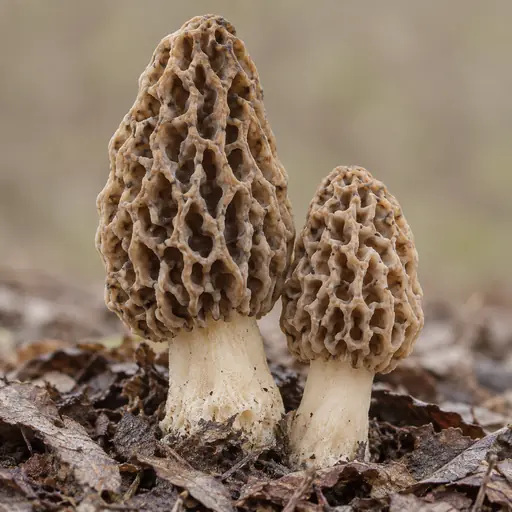
A mushroom with a cap like a honeycomb. It comes up in spring.
How to recognise it
The cap is a honeycomb of pits and ridges. It can be yellowish, grey-brown or almost black. It sits on a pale stem. Cut every morel in half lengthways. A true morel is one single hollow from the cap tip to the stem base. Its cap joins the stem at its lower edge. The deadly false morel (Gyromitra esculenta) has a brain-like, reddish-brown head. Inside, it is chambered or cottony. Cooking does not make it safe. Verpa bohemica has a cap attached only at the very top, like a thimble. Its stem is stuffed with cottony pith.
Where it grows
Look on the ground in open broadleaf and river woods, old orchards and gardens. Morels often grow by ash, elm, poplar or apple, on lime-rich soil or bark mulch. In the eastern US, look by dying elms, ash and old apple trees. In the western US they come up in conifer forest the spring after a fire.
When
Morels come from March to May. They appear earlier in the lowlands of southern Europe. In the north and in the mountains they come later, into June. They follow soaking spring rain once the soil warms. In the mountains of the western US they follow the melting snow.
Picking
Cut the stem at ground level with a knife. Carry morels in a basket or mesh bag. In Germany all morels are protected and you may take small amounts for your own use only. Elsewhere, many regions and US national forests set limits or ask for a permit. Check the local rules.
Cooking
Once you have identified them with certainty, cook morels thoroughly. Raw or undercooked morels are toxic and that includes dried ones. France's food-safety agency ANSES advises 20 to 30 minutes in the pan for wild mushrooms. Large meals have caused dizziness and trembling, even when the morels were cooked. So keep portions modest. They suit butter, cream, asparagus and chicken.
Keeping
They keep two days in the fridge, in a paper bag. Morels dry very well. Soak dried morels, then strain the soaking water into the sauce. Cook them as long as fresh ones.
Toxic look-alikes
- Gyromitra esculenta · Deadly - do not eat
- Verpa bohemica · Toxic - do not eat
Sources: Identification and habitat: Missouri Department of Conservation and First Nature. Toxicity and cooking: ANSES and Lagrange and Vernoux (Toxins, 2020). Rules: German Federal Species Protection Ordinance and US Forest Service. Season: GBIF records.
Always consult an expert before consuming any wild food. This information is for educational purposes only.