

Hen of the Woods
Grifola frondosa
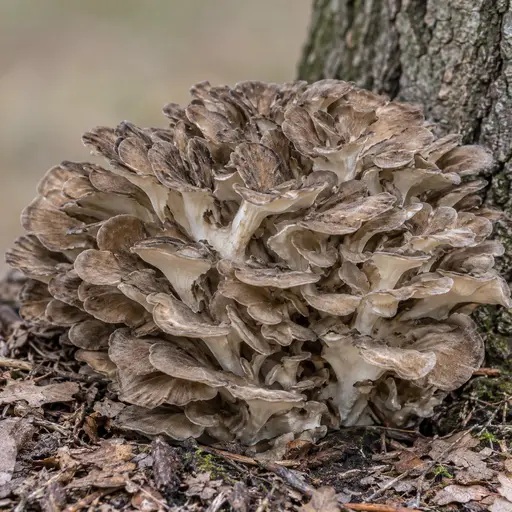
A big rosette of overlapping grey-brown fronds at the foot of old oaks, with white pores underneath.
How to recognise it
Hen of the woods forms a rosette 15 to 40 cm across. It is made of many overlapping grey-brown caps, shaped like spoons or fans and each 3 to 14 cm wide. They branch from a shared white base. The underside is white with tiny pores, not gills. The flesh is white and firm and does not stain when cut or bruised. The black-staining polypore (Meripilus) has larger, thicker caps that bruise black. The umbrella polypore (Polyporus umbellatus) has round caps on small central stems.
Where it grows
Look at the base of old oaks. Sometimes it grows on stumps or on other broadleaf trees. It rots the roots and comes back to the same tree for years. It is common in the eastern US and rare in the West. In Europe it is uncommon and declining, found under old oaks and sweet chestnuts.
When
It fruits from late summer to late autumn, mostly in September and October. It often appears after the first cool nights that follow rain.
Picking
Cut the rosette at the base with a knife. Take only fresh, firm ones and leave the tree to fruit again. In Europe it is protected by law in Poland, Estonia, Latvia and Lithuania. It is red-listed in Germany, Austria and elsewhere. Check the local rules.
Cooking
Once it's identified with certainty, cook it thoroughly. Shake and rinse soil and insects from between the caps and trim the tough core. Fry or roast it. The caps crisp at the edges and taste rich, earthy and slightly peppery.
Keeping
It keeps several days in the fridge in a paper bag. It freezes well after cooking and it dries well.
Sources: Identification and habitat: MushroomExpert.com. Status in Europe: IUCN Red List.
Always consult an expert before consuming any wild food. This information is for educational purposes only.