

Boletus (porcini & bay bolete)
Boletus
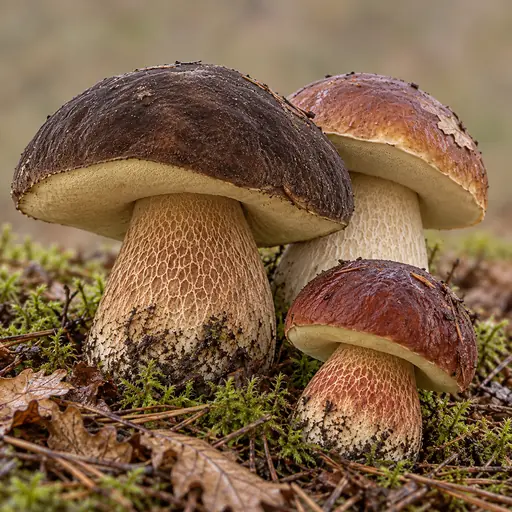
Porcini and the bay bolete together: porcino, pine, bronze and summer bolete, the bay bolete in Europe and the North American kings.
How to recognise it
This group brings together several boletes. In Europe there are the porcini (Boletus edulis) and the pine, bronze and summer boletes. North America adds the eastern king bolete and the Rocky Mountain king. The bay bolete (Imleria badia) belongs here too. The porcini and kings have white pores when young, a net on the stem and white flesh that does not turn blue. The bay bolete has yellow pores that bruise blue-green and a streaky stem without a net. The cap tells them apart. It is brown and greasy on the porcino, wine-red on the pine bolete and near-black and velvety on the bronze bolete. The summer bolete's cap is pale and cracked. The eastern king's is tan to lilac-brown. The Rocky Mountain king has a brick-red cap and the bay bolete a chestnut, tacky one. Red or orange pores mean a toxic bolete, such as the devil's bolete (Rubroboletus satanas). Pink pores and a dark stem net mean the bitter bolete (Tylopilus felleus).
Where it grows
All of them live with trees. Porcini grow with conifers, beech and oak. The pine bolete grows with pine and spruce. The bronze and summer boletes like oak and chestnut in warm woods. The bay bolete grows with conifers on acid sand. The eastern king grows in eastern US oak woods and the Rocky Mountain king under high spruce.
When
Between them they run from May to the first frosts. The summer bolete starts in May. At the other end, the bay bolete peaks in October and November. Porcini fruit mainly from August to October. Flushes follow a soaking rain by two to three weeks.
Picking
Only pick what you can name with certainty and keep each kind apart in your basket. Germany allows porcini only in small amounts for your own use and protects the bronze bolete. Italy and Spain often require permits.
Cooking
Identify each one with certainty first. Then brush them all, slice them to check for maggots and cook them through. The bay bolete gathers radioactive caesium. In parts of Bavaria and Austria, eat it only now and then.
Keeping
They all dry well in thin slices.
Toxic look-alikes
- Rubroboletus satanas · Toxic - do not eat
- Rubroboletus rhodoxanthus · Toxic - do not eat
- Neoboletus subvelutipes · Toxic - do not eat
- Boletus sensibilis · Toxic - do not eat
- Boletus huronensis · Toxic - do not eat
- Rubroboletus pulcherrimus · Toxic - do not eat
- Rubroboletus eastwoodiae · Toxic - do not eat
- Rubroboletus legaliae · Toxic - do not eat
- Leccinum insigne · Toxic - do not eat
- Tylopilus felleus · Not edible
- Tylopilus rubrobrunneus · Not edible
- Tylopilus plumbeoviolaceus · Not edible
Sources: Identification and habitat: Regione Piemonte, First Nature and MushroomExpert. Season: GBIF records. Rules: BArtSchV (Germany). Caesium: German Federal Office for Radiation Protection (BfS).
Always consult an expert before consuming any wild food. This information is for educational purposes only.