

Sweet Violet
Viola odorata
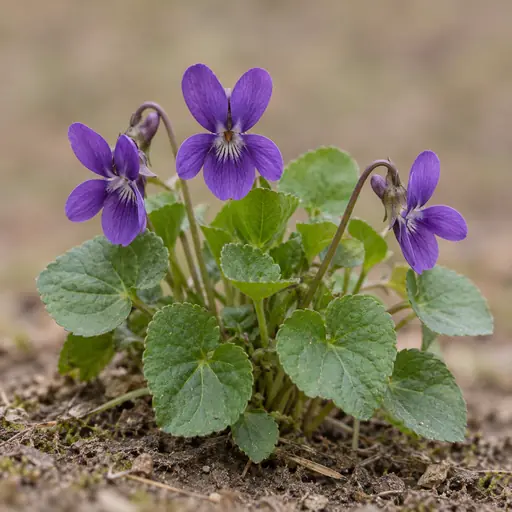
Small purple flowers with heart-shaped leaves and a sweet scent.
How to recognise it
Sweet violet is a low plant with a rosette of long-stalked leaves. They are heart-shaped with a rounded base, scalloped edges and short hairs. It spreads by long runners that root. Each flower rises on its own stalk from the rosette. It has five uneven petals and the lowest has a short spur at the back. The flowers are usually deep violet, sometimes white, with blunt sepals and a sweet scent. Dog violets look similar but have no scent. Lesser celandine is poisonous and grows in the same places. It has glossy, fleshy, hairless leaves and flowers with 8 to 12 shiny yellow petals. Lords-and-ladies is poisonous too. It has glossy, arrow-shaped leaves with lobes pointing backwards.
Where it grows
Look at woodland edges, on hedge banks and in shady grass, churchyards, parks and old gardens. It likes moist, rich soil in part shade. It grows across most of Europe and has escaped from gardens in many places. In the US it grows wild locally, in lawns and woodland edges.
When
It flowers from February to May, earlier in the mild south. In much of the US it flowers in April and May. A few flowers sometimes appear again in late summer. The leaves are best young, in spring.
Picking
Pick a few flowers and young leaves from each patch. Leave the rosette and roots in the ground and never dig up plants. Avoid sprayed lawns, verges and places where dogs are walked.
Cooking
Once you're certain of the identification, you can put the flowers raw on salads and desserts. You can also candy them with pasteurised egg white and fine sugar. Or steep them in boiling water and sweeten it for violet syrup. Young leaves are eaten raw in salads or cooked like spinach. They are mild and slightly thicken soups. Never eat the roots or seeds, which can cause vomiting. Try a small amount first.
Keeping
The flowers wilt fast. Keep them between damp paper towels in the fridge and use them the same day. Candied flowers keep in an airtight container in a cool, dark place.
Toxic look-alikes
- Arum maculatum · Toxic - do not eat
- Ficaria verna · Toxic - do not eat
Sources: Identification and habitat: NatureSpot and NC State Extension. Cooking: Colorado State University Extension and NC State Extension.
Always consult an expert before consuming any wild food. This information is for educational purposes only.