

Lingonberry
Vaccinium vitis-idaea
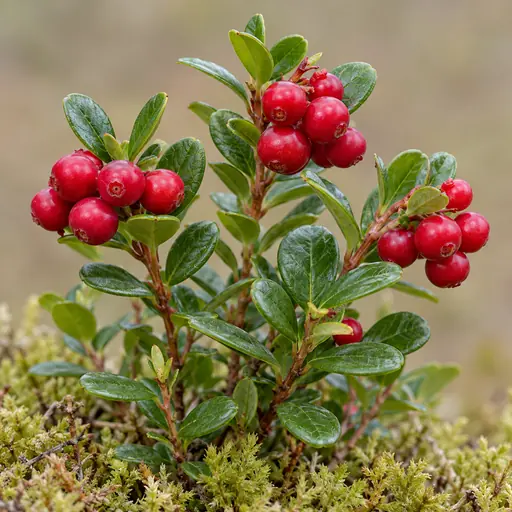
Small, red, tart berries on low evergreen shrubs in acid soil.
How to recognise it
Lingonberry, also called cowberry, is a creeping evergreen dwarf shrub. Its leaves are thick, glossy and dark green, with edges that roll under. The pale underside is speckled with tiny dark dots. Small white to pink bell-shaped flowers grow in short clusters at the shoot tips. They give round, glossy red berries that hang in small bunches. Bearberry (Arctostaphylos uva-ursi) is a trailing shrub of the same places. It has net-veined leaves without dots and dry, mealy berries. The poisonous red and black berries do not grow on a low evergreen carpet. Yew (Taxus) is a tree or tall shrub with flat needles. Its red cup is open at the end around a dark seed. Mezereon (Daphne mezereum) is an upright shrub with berries pressed along the stem. Deadly nightshade (Atropa bella-donna) is a tall herb with black berries. Red baneberry (Actaea) and lily of the valley (Convallaria majalis) are soft herbs.
Where it grows
It needs acid, poor soil. Look in pine and spruce forests, birch woods, heaths, moorland and on mountain slopes above the treeline. It is very common in Scandinavia and the Baltic states and is found in the Alps and other mountains. In North America it grows mainly in Canada and Alaska. It reaches the US only in the far north, from Minnesota to Maine. There it is rare and in Wisconsin it is endangered.
When
The berries turn red from August. They are best when fully dark red, from September into October. They hang on the plants into winter.
Picking
Pick dark red berries by hand, or with a berry picker where that is allowed. In Sweden, Finland and Norway, everyman's right lets anyone pick wild berries away from houses and gardens. Nature reserves can have their own rules, though. In central Europe, Bavaria's health authority (LGL) says eating wild berries has not been shown to be a risk factor for fox tapeworm. It still advises washing them well. Only heating above 60 °C kills its eggs and home freezing does not.
Cooking
Raw berries are sour and slightly bitter. So once you've identified them with certainty, you usually cook them with sugar into a sauce or jam. In Sweden people also stir them raw with sugar. Serve them with meatballs, game, roasts, potato pancakes or porridge.
Keeping
They keep longer in the fridge than most berries. Stirred with sugar, they keep cool for a long time thanks to their natural benzoic acid. They freeze well as they are.
Toxic look-alikes
- Convallaria majalis · Deadly - do not eat
- Atropa bella-donna · Deadly - do not eat
- Taxus baccata · Deadly - do not eat
- Taxus brevifolia · Deadly - do not eat
- Daphne mezereum · Toxic - do not eat
- Actaea rubra · Toxic - do not eat
Sources: Identification and range: Minnesota Wildflowers and CREA Mont-Blanc. Picking rights: Swedish Environmental Protection Agency. Fox tapeworm: Bavarian State Office for Health and Food Safety (LGL).
Always consult an expert before consuming any wild food. This information is for educational purposes only.