

Rose Hips
Rosa canina
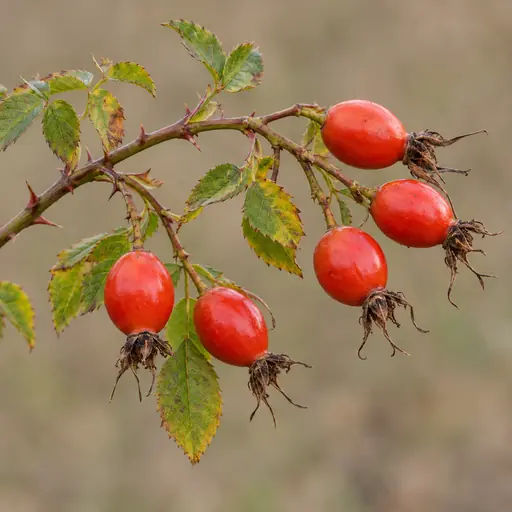
The red autumn fruits of wild roses. They are rich in vitamin C and the seeds inside are wrapped in itchy hairs.
How to recognise it
Dog rose is a shrub with long arching stems and strongly hooked prickles. Its leaves have 5 to 7 toothed leaflets. The hips are oval, smooth and glossy scarlet, 1 to 2 cm long. When ripe they have no sepals left on them. Inside, hard seeds sit in fine, irritant hairs. Black bryony, white bryony and bittersweet grow in the same hedges. They hang shiny red, poisonous berries in bunches, on climbing stems without prickles. A rose hip grows on a prickly rose stem and is full of hairy seeds.
Where it grows
Dog rose grows in hedgerows, scrub, woodland edges and rough grassland across Europe. You find it from the lowlands into the mountains. In the US dog rose grows wild in places. There you can use the hips of native wild roses and of rugosa rose the same way.
When
Hips ripen from September to November. Many stay on the bush into winter. Frost makes them softer and sweeter. But the longer they hang, the less vitamin C they hold.
Picking
Pick firm, fully coloured hips that give a little when pressed. Take a few from each bush and leave plenty for birds. Wear gloves and avoid roadsides and sprayed hedges.
Cooking
Once you're certain of them, eat only the pulp. The seeds and their hairs irritate the mouth, gut and skin. Cut off the stalk and tip, halve the hips and scrape out every seed and hair. Or simmer them whole and press them through a fine sieve. Then strain the juice again through muslin. Use the pulp for syrup, jelly, jam and tea. It goes well with apple.
Keeping
Fresh hips keep about a week in the fridge. They freeze well. Seeded halves dried at no more than 50 °C keep for many months in an airtight jar.
Toxic look-alikes
- Dioscorea communis · Toxic - do not eat
- Bryonia cretica · Toxic - do not eat
- Solanum dulcamara · Toxic - do not eat
Sources: Identification and habitat: Woodland Trust and The Wildlife Trusts. Season, picking and cooking: University of Alaska Fairbanks Cooperative Extension and Bundeszentrum für Ernährung (BZfE).
Always consult an expert before consuming any wild food. This information is for educational purposes only.