

Chestnut
Castanea sativa
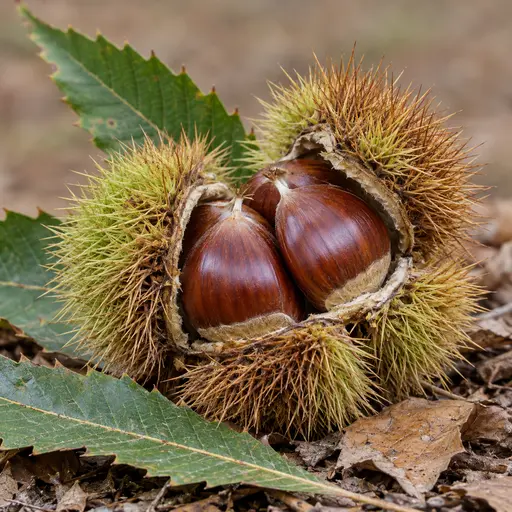
Big, sweet nuts in spiny green husks that split open when they are ripe.
How to recognise it
Sweet chestnut leaves are long, narrow and glossy, 16 to 28 cm long. They have sharp saw teeth and many straight, parallel veins. The husk is covered all over in long, fine spines as sharp as needles. It usually holds two or three nuts. They are flattened on one or both sides and end in a small point with a tuft. Don't confuse it with the toxic horse chestnut (Aesculus hippocastanum) of parks and streets. That tree has hand-shaped leaves of five to seven leaflets. Its thick green husk has only a few short spikes. Inside are one or two round, glossy conkers with no point. In North America the buckeyes (other Aesculus) are toxic too. A tree with hand-shaped leaves is never a sweet chestnut.
Where it grows
It is native to southern Europe, western Asia and North Africa and has long been planted for its nuts. It grows on acid, well-drained soil and avoids limestone. Large chestnut woods cover hills from northern Portugal and Galicia to the Cévennes, Corsica and the Apennines. In the US most chestnuts are planted. Blight nearly wiped out the native species.
When
The nuts fall from late September to early November, mostly in October. They come earlier in the lowlands than in the mountains.
Picking
Go every few days and gather the nuts that have fallen on their own. Wear thick gloves, or roll the husks open under your boot. Leave nuts with small holes, which come from weevil or moth larvae. Many chestnut woods are private and the nuts on the ground belong to the owner. Check the local rules.
Cooking
Once you are sure they are sweet chestnuts, cook them. Raw, they are astringent and hard to digest. Throw away any that float in water. Cut a slit in the shell so they don't burst. Then roast them, or simmer them for about 30 minutes. Peel off the shell and the bitter inner skin while they are warm. They are sweet and floury and go into soups, stuffings and purées.
Keeping
At room temperature fresh chestnuts go mouldy within about two weeks. In the fridge they keep about two months. You can also freeze or dry them.
Toxic look-alikes
- Aesculus hippocastanum · Toxic - do not eat
Sources: Identification: Woodland Trust, ANSES and Oregon State University Extension. Harvest, cooking and storage: Oregon State University Extension.
Always consult an expert before consuming any wild food. This information is for educational purposes only.