

Wild Artichoke
Cynara cardunculus
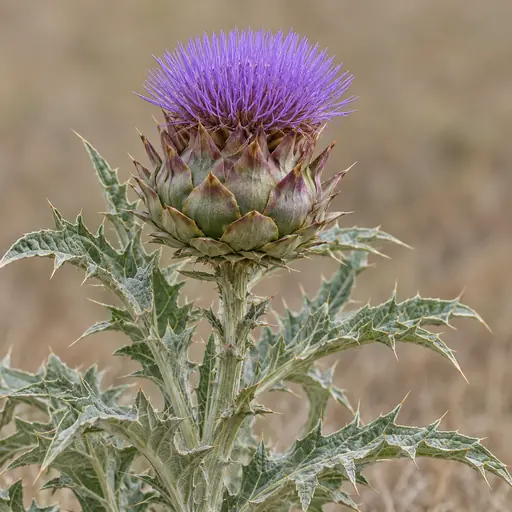
A thistle-like plant, related to the garden artichoke. You eat its flower buds and stems.
How to recognise it
Wild artichoke, also called wild cardoon, forms a large rosette of deeply cut leaves. They are silvery grey-green on top and almost white underneath, felted with hairs. Each lobe ends in a stiff yellow spine. In late spring a stiff, branched stem grows up to head height. It carries heads like small artichokes, wrapped in spine-tipped bracts. These open into blue-purple thistle flowers. Watch out for Atractylis gummifera, a deadly Mediterranean thistle. People have mistaken it for wild artichoke and it has killed people in Morocco. It has no stem. Its pink flower head sits flat in the middle of the spiny rosette. It flowers in late summer and autumn. Its root oozes a sticky gum. Never eat a stemless thistle rosette or a thistle root.
Where it grows
It likes dry, sunny, open ground. You find it in pastures, at field edges, on roadsides, on fallow land and in scrub, often on clay. It is native to the Mediterranean, from Portugal to Greece and North Africa. In northern and central Europe it is only a garden escape. In California it is an invasive weed of grassland and coastal scrub below 500 m. Elsewhere in the US it is a garden plant.
When
The rosette grows after the autumn rains and right through the mild winter. You pick the leaf stalks from late winter to spring. The heads come in late spring and early summer. It flowers mainly in June and July. Then it dries off in the summer drought.
Picking
Wear thick gloves and cut the stalks or heads with a knife. Leave the root in the ground. In its native range, leave some heads to flower. California is different, because there it is invasive. Take heads before they seed and never move seed heads around. Check local rules on public land.
Cooking
Be certain of your identification before you start. Peel the spines and strings off the leaf stalks. Drop the pieces into lemon water straight away, because they blacken. Boil them until tender. They taste like a bitter artichoke and people stew them or fry them in batter. From the heads, strip off the spiny bracts and eat the tender base and heart. The dried flowers curdle milk for cheeses such as Serra da Estrela and Torta del Casar.
Keeping
The stalks keep a few days in the fridge, wrapped in a damp cloth. Once boiled, they freeze well.
Toxic look-alikes
- Chamaeleon gummifer · Deadly - do not eat
Sources: Identification, range and season: IUCN Global Invasive Species Database and California Invasive Plant Council. Atractylis poisonings: Moroccan poison control data.
Always consult an expert before consuming any wild food. This information is for educational purposes only.