

Sloes
Prunus spinosa
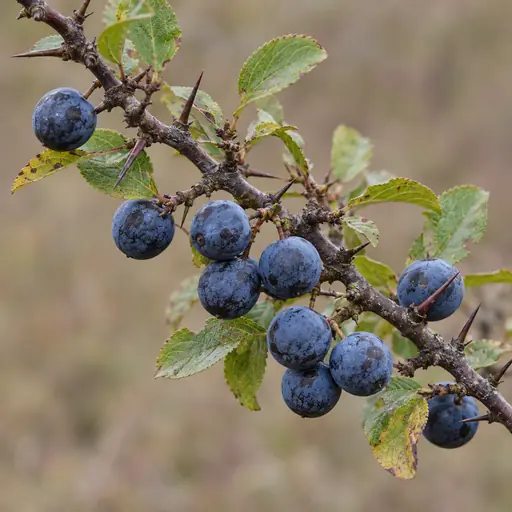
The small blue-black fruits of the thorny blackthorn. They have a dusty bloom and taste fiercely sour.
How to recognise it
Sloes grow on blackthorn. It is a dense, woody shrub with dark bark and its side twigs end in sharp thorns. The white blossom opens in March and April, before the leaves. The fruit is round and about 1 cm across. It is blue-black with a dusty bloom that rubs off. Sloes grow singly or in pairs along the twigs. Inside, green and very astringent flesh surrounds one stone. Buckthorn has shiny black berries in clusters, with no bloom. Deadly nightshade is a soft, leafy herb, not a thorny shrub. Its shiny black berries grow singly, each sitting in a green star of sepals.
Where it grows
Blackthorn grows in hedgerows, scrub and woodland edges and on sunny, stony slopes. It often forms thickets that spread by suckers. You find it across most of Europe, north and south, from the lowlands into the hills.
When
Sloes ripen from September to November. They are ready when they are dark and soft enough to squash between your fingers. People traditionally pick them after the first frost. Frost splits the skins and softens the fruit, so the juice runs out. You can pick them earlier and freeze them overnight, which does the same.
Picking
Wear gloves, because the thorns are long and sharp. Pick from several bushes and leave plenty for birds. Avoid roadside hedges and sprayed field edges.
Cooking
Make sure they're sloes first. They are too sour and astringent to eat raw. But they make sloe gin and other liqueurs, such as Spanish pacharán in anise spirit. They also make a jelly with apples. For gin, prick or freeze them, then cover them with sugar and gin. Leave them a few months in a dark place and shake them now and then. Then strain. Never crush or crack the stones. The kernels contain amygdalin, which releases cyanide.
Keeping
Fresh sloes keep a few days in the fridge. Frozen in sealed bags they keep for months. They go straight from the freezer into the jar.
Toxic look-alikes
- Atropa bella-donna · Deadly - do not eat
- Rhamnus cathartica · Toxic - do not eat
Sources: Identification, habitat and the frost tradition: Woodland Trust. Stones: USDA Phytochemical and Ethnobotanical Databases.
Always consult an expert before consuming any wild food. This information is for educational purposes only.