

Elderflower
Sambucus nigra
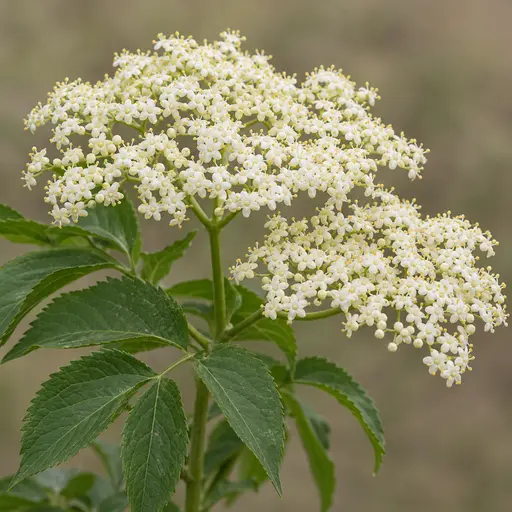
Creamy white flowers in big flat clusters on elder trees.
How to recognise it
Elder is a woody shrub or small tree with corky, furrowed, grey-brown bark. Its leaves are opposite, with 5 to 7 toothed leaflets. They smell unpleasant when you crush them. In late spring it carries flat, branching heads of tiny creamy white flowers. These have pale yellow anthers and a sweet, musky scent. Danewort, or dwarf elder, is a soft herb that dies back each winter. It has upright heads and purple anthers. Red elder flowers earlier, in egg- or dome-shaped clusters. Both are toxic. Hemlock, water hemlock and giant hogweed are soft green herbs, not woody shrubs. Giant hogweed's sap burns skin in sunlight. Hemlock has a smooth, hollow, purple-blotched stem and a mousy smell. In all three, the flower stalks spread from one point like the spokes of an umbrella.
Where it grows
It grows in hedgerows, at woodland edges, in scrub, on riverbanks and on waste ground. It is often near houses, on rich soil. It is common across Europe, from the lowlands into the hills. In the US, the native American elder in the East and blue elder in the West grow in similar places.
When
In northern and central Europe elder flowers from late May into June. In the warm south it starts earlier. In the eastern US, American elder flowers later and over a longer spell, mostly in June and July.
Picking
Pick on a dry, sunny morning. Choose heads that are fully open, creamy and sweet-smelling. Pass over browning ones. Cut or snap them at the base. Take only a few from each bush so it can still bear berries. Shake out insects gently.
Cooking
When you're certain it's elder, use only the flowers. Strip them from the stalks, because stalks, leaves, bark, roots and unripe berries are poisonous. Steep the flowers in hot sugar syrup with lemon to make cordial. You can also dip whole heads in batter and fry them as fritters. Don't eat the thick stalk. Or dry the flowers for tea. The taste is sweet and floral, good with gooseberries and strawberries. The berries that follow in autumn must be cooked.
Keeping
The flowers fade fast, so use them the day you pick them. Heads dried in the shade keep for tea in an airtight jar. Cordial keeps a few weeks in the fridge, or you can freeze it.
Toxic look-alikes
- Conium maculatum · Deadly - do not eat
- Cicuta virosa · Deadly - do not eat
- Sambucus ebulus · Toxic - do not eat
- Sambucus racemosa · Toxic - do not eat
- Heracleum mantegazzianum · Toxic - do not eat
Sources: Identification and habitat: Woodland Trust and BSBI. Look-alikes: University of Minnesota Extension. Picking and cooking: Penn State Extension and UMass Extension.
Always consult an expert before consuming any wild food. This information is for educational purposes only.