
Bay Bolete
Imleria badia
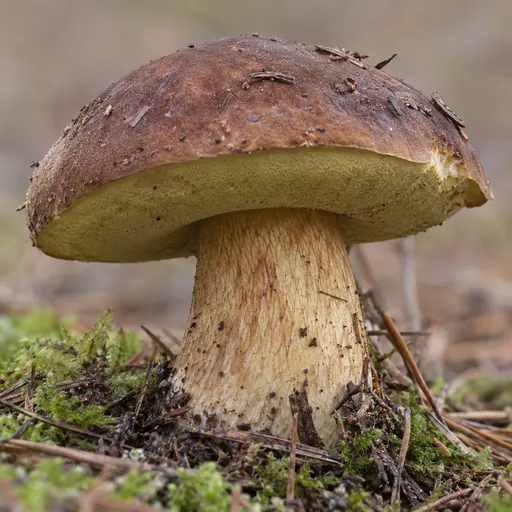
A bolete with a chestnut-brown cap that turns sticky when wet. Its pores bruise blue-green and its streaky stem has no net.
How to recognise it
This is a bolete without the porcini's net on the stem. The cap is chestnut brown. It feels like suede when dry and turns sticky when wet. The pores are cream to pale yellow (later olive) and bruise blue-green. The flesh is white to pale yellow and may turn faintly blue when you cut it. The stem is slimmer and streaked brown on a paler background. Red or orange pores rule it out (Rubroboletus satanas, Neoboletus subvelutipes). So do pink pores with a netted stem (Tylopilus felleus). In eastern North America there are two more to know. Boletus sensibilis turns dark blue instantly all over and has a yellow stem. Boletus huronensis is dense and shaped like a porcino, with a yellowish stem.
Where it grows
It grows with pine and spruce and also with beech, oak and chestnut. It likes acid, sandy soil and often sits in moss near old stumps. It is common in the lowlands of northern and central Europe. In North America it grows in the north-east, around the Great Lakes and in the Appalachians, under pine and hemlock.
When
In Europe it fruits from August until the first hard frosts. It peaks in October (after the porcini) and runs into December in the south. In north-eastern North America it comes earlier, mainly from July to September.
Picking
Twist it out or cut it and leave the young and the old ones. Check the local rules, as picking is often banned in nature reserves.
Cooking
First make sure of your identification. Wipe the cap and peel it if it is slimy. Remove any soft old tubes and cook it through. Any blue disappears in cooking and the taste is mild. It gathers more radioactive caesium than most mushrooms. In parts of Bavaria and Austria, eat it only now and then.
Keeping
It dries well in thin slices. It also freezes well once cooked.
Toxic look-alikes
- Rubroboletus satanas · Toxic - do not eat
- Rubroboletus rhodoxanthus · Toxic - do not eat
- Neoboletus subvelutipes · Toxic - do not eat
- Boletus sensibilis · Toxic - do not eat
- Boletus huronensis · Toxic - do not eat
- Rubroboletus pulcherrimus · Toxic - do not eat
- Rubroboletus eastwoodiae · Toxic - do not eat
- Rubroboletus legaliae · Toxic - do not eat
- Tylopilus felleus · Not edible
- Tylopilus rubrobrunneus · Not edible
- Tylopilus plumbeoviolaceus · Not edible
Sources: Identification and habitat: First Nature and MushroomExpert. Season: GBIF records. Caesium: German Federal Office for Radiation Protection (BfS) and Bavarian LGL.
Always consult an expert before consuming any wild food. This information is for educational purposes only.