

Cloudberry
Rubus chamaemorus
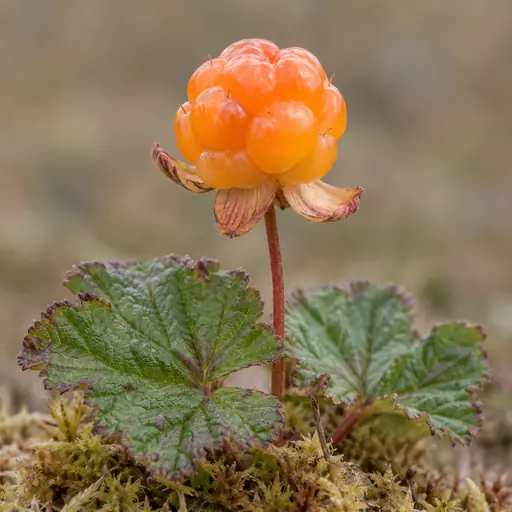
An amber-orange berry from northern bogs. It looks like a soft raspberry and the Nordic countries love it.
How to recognise it
Cloudberry is a low herb, not a shrub, about a hand high. It rises from creeping stems under the ground. Each upright shoot carries one to three round, wrinkled leaves with five to seven shallow lobes. It has a single white flower. Male and female flowers grow on separate plants, so only some shoots bear fruit. The berry looks like a raspberry made of a few large drupelets. It is hard and red at first. When ripe it turns soft and amber-orange.
Where it grows
It grows on open bogs, wet heath, mires and tundra, often among sphagnum moss and dwarf birch. It is common in Norway, Sweden, Finland, the Baltic states and Russia. You also find it on high moorland in Scotland and northern England. In Germany, Poland and the Czech Republic it survives only in a few bogs, as a relic of the Ice Age. There it is protected or listed as endangered.
When
It flowers in June. The berries ripen from mid-July in the south of Scandinavia and the Baltic. In the far north and in the mountains they ripen in August. A frost at flowering time can ruin a year's crop.
Picking
Only pick soft, amber berries that come off easily. Hard red ones are not ripe. Everyman's right lets anyone pick them in Sweden, Finland and Norway. In Nordland, Troms and Finnmark, though, the landowner may ban picking on productive cloudberry bogs. The ban is announced by signs or in a newspaper. You may then still eat berries on the spot. On public land in Finnmark, only residents may pick them to sell. Nature reserves can have their own rules. In central Europe the plant must be left alone. Check the local rules before you go.
Cooking
Be sure of what you have first. Then eat them fresh with cream or on waffles, or cook them into jam. In Finland the jam goes with warm squeaky cheese (leipäjuusto). In Sweden it goes over ice cream. The taste is tart and aromatic.
Keeping
Ripe berries keep only a day or two in the fridge. They freeze well. Their natural benzoic acid helps the jam keep.
Sources: Identification and habitat: University of Alberta and Minnesota Wildflowers. Picking rules: Norwegian Environment Agency and Swedish Environmental Protection Agency. Status in central Europe: Czech and German red lists.
Always consult an expert before consuming any wild food. This information is for educational purposes only.