

Fiddleheads
Matteuccia struthiopteris
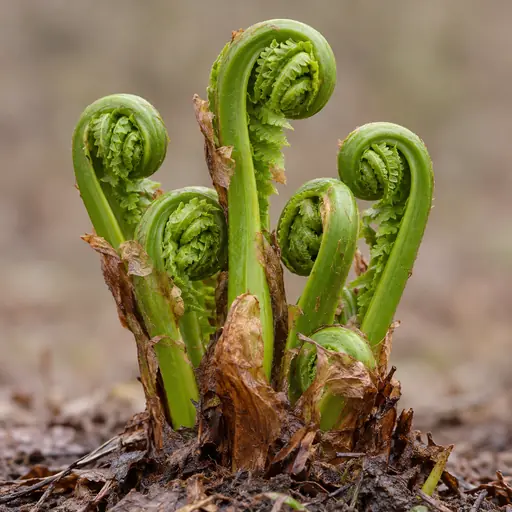
The tightly curled young fronds of the ostrich fern. They are smooth and bright green, with brown papery scales.
How to recognise it
Only the ostrich fern is picked. It grows in clumps, called crowns, of about three to twelve fiddleheads. These are tight green coils about 2.5 cm across. The stem is smooth, with a deep U-shaped groove on its inner side. Thin brown papery scales cover them and rub off. Last year's fertile fronds often still stand in the clump. They are dark brown, stiff and shaped like feathers. Bracken is carcinogenic. It comes up singly from creeping stems under the ground. Its stem is fuzzy and round, it has no papery scales and its top branches in three. Other ferns, such as cinnamon fern, have woolly fiddleheads and are not recommended.
Where it grows
It grows on shaded river floodplains and sandbars and in rich, moist woods, often under maple and ash. In the US it is common in the Northeast and around the Great Lakes. It reaches south to Pennsylvania and west to the Dakotas. In the West it is rare outside Alaska. In Europe it grows along streams in the north and centre.
When
Fiddleheads come up in spring as the ground warms after snowmelt and floods. In southern Maine that means late April. In the far north it is mid to late May and in places into early June. Pick them while they are 5 to 15 cm tall and tightly coiled. Within days they unroll and are past eating.
Picking
Only pick from healthy clumps with at least four fiddleheads. Take no more than half and don't come back that season. Picking them all weakens or kills the fern. Ask the landowner first. In Germany the wild ostrich fern is protected by law, so leave it there.
Cooking
Never eat fiddleheads raw or lightly cooked. They have caused outbreaks of food poisoning, with nausea, vomiting, diarrhoea and cramps, investigated by the US CDC. Make sure of your identification first. Rub off the brown scales and wash them in several changes of cold water. Then boil them in small batches in plenty of salted water for 15 minutes. Or steam them for 10 to 12 minutes. Throw the water away. Only then sauté them or add them to dishes. They taste of asparagus and green beans.
Keeping
Keep them in the fridge and use them within a week. To freeze them, blanch small batches for 2 minutes. Cool them in ice water, drain them and freeze them. They still need the full 15 minutes of boiling before you eat them.
Toxic look-alikes
- Pteridium aquilinum · Toxic - do not eat
Sources: Identification, season, picking and cooking: University of Maine Cooperative Extension. Food poisoning: US CDC. US range: Penn State Extension. Protection in Germany: Federal Species Protection Ordinance (BArtSchV).
Always consult an expert before consuming any wild food. This information is for educational purposes only.