

Chanterelles (all)
Cantharellus
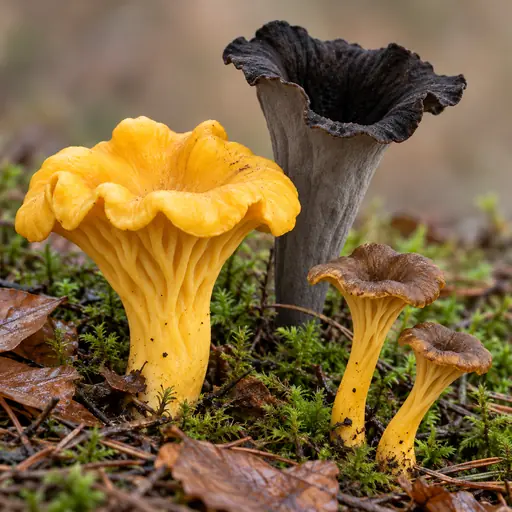
Every chanterelle together: the golden chanterelle, the black trumpet, the winter chanterelle and, in North America, the smooth and Pacific chanterelles.
How to recognise it
This group holds five species. They are the golden chanterelle, the smooth and Pacific chanterelles of North America, the black trumpet and the winter chanterelle. The last two belong to the close genus Craterellus. All of them have blunt, forking ridges or a nearly smooth underside running down the stem. They never have thin, blade-like gills. The golden, smooth and Pacific chanterelles are yellow to orange and fleshy, with a solid stem. The winter chanterelle is small, with a brown cap and a hollow yellow stem. The black trumpet is a thin, hollow, grey-black horn. Each has its own dangerous look-alike. For the yellow ones it is the jack-o'-lantern (Omphalotus), with true gills and clusters on wood. Among winter chanterelles it is the deadly webcap (Cortinarius rubellus), with rusty-brown gills.
Where it grows
All of them live with tree roots. The golden chanterelle grows under broadleaves and conifers across Europe and North America. The black trumpet likes damp leaf litter, mainly under beech and oak. The winter chanterelle grows on wet moss and rotten wood under conifers. The smooth chanterelle belongs to eastern US oak woods. The Pacific chanterelle belongs to the Douglas fir and hemlock forests of the Pacific Northwest.
When
Together they run from early summer to winter. Golden and smooth chanterelles come from early summer, after warm rain. Black trumpets follow from late summer through autumn. Pacific and winter chanterelles run from autumn into winter, until hard frost. In the western US they follow the autumn and winter rains.
Picking
Cut or twist them at the base. Leave the small ones and take only what you will eat. In Germany the golden chanterelle is specially protected. You may pick only small amounts there, for your own use. Other countries, regions and US public lands set their own limits or permits, so check the local rules.
Cooking
Identify each mushroom with certainty first. Cook them all well and never eat them raw. Golden, smooth and Pacific chanterelles are fruity and firm. They are best fried slowly in butter. Black trumpets taste smoky and winter chanterelles earthy. Both are good in sauces and risotto and with eggs. Split trumpets and winter chanterelles lengthwise to rinse out the grit.
Keeping
Fresh, they keep a few days in the fridge in paper, not plastic. Black trumpets and winter chanterelles dry very well. Golden chanterelles turn tough when dried. They are better fried and frozen.
Toxic look-alikes
- Cortinarius rubellus · Deadly - do not eat
- Omphalotus olearius · Toxic - do not eat
- Omphalotus illudens · Toxic - do not eat
- Omphalotus olivascens · Toxic - do not eat
- Omphalotus subilludens · Toxic - do not eat
- Turbinellus floccosus · Toxic - do not eat
- Hygrophoropsis aurantiaca · Not edible
Sources: Identification and habitat: First Nature (UK), MushroomExpert.com and MykoWeb (California Fungi). Deadly webcap: Norwegian Institute of Public Health. Protection: German Federal Species Protection Ordinance. Season: GBIF records.
Always consult an expert before consuming any wild food. This information is for educational purposes only.