

Wild Asparagus
Asparagus acutifolius
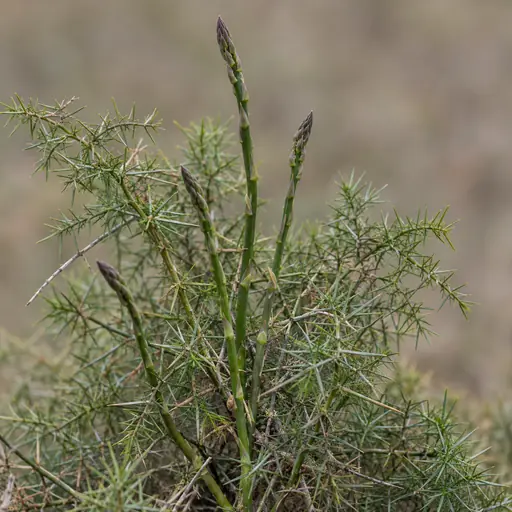
A perennial whose slender shoots come up in spring.
How to recognise it
Wild asparagus is a tangled, evergreen, woody shrub up to about 1.5 m tall. It has no true leaves. Instead it has tufts of short, stiff, needle-like green branchlets, each ending in a sharp spine. Its black berries are not eaten. In spring, thin shoots push up from the base of the old spiny bush. They are dark green to purplish and often thinner than a pencil. Small pointed scales lie pressed to the stem and there are no leaves. Black bryony and white bryony are poisonous climbers of the same hedges and they also sprout in spring. Black bryony soon unfolds glossy heart-shaped leaves. White bryony is hairy, with lobed leaves and tendrils. Only pick shoots that rise from an asparagus bush you can see.
Where it grows
It grows in Mediterranean scrub, at the edges of holm oak and pine woods, in olive groves and hedges and along stone walls and roadsides. You find it from the coast into the hills of Portugal, Spain, southern France, Italy, the Balkans and Greece. It does not grow wild in northern and central Europe. Asparagus there is garden asparagus gone wild, mostly on sandy ground.
When
The shoots come up from late winter to spring, after the autumn and winter rains. On warm coasts they start in February. In the hills they run into April and May. Rain followed by mild, sunny days brings a new flush.
Picking
Snap each shoot by hand where it breaks easily. Leave some on every bush and never cut or uproot the bush. In Italy each region sets its own rules. Tuscany, for example, allows picking only until 31 May. In Spain the landowner and the regional government decide. Parks often ban picking. Check the local rules.
Cooking
When you're sure what you have, use only the tender part above where the shoot snaps. It is more bitter than garden asparagus. Cook it briefly. It is good in omelettes and scrambled eggs, risotto or pasta, or sautéed with garlic and olive oil.
Keeping
It is best eaten the same day. It keeps a few days in the fridge standing in a little water. You can also blanch and freeze it.
Toxic look-alikes
- Dioscorea communis · Toxic - do not eat
- Bryonia cretica · Toxic - do not eat
Sources: Identification, habitat and season: Mediterranean floras and the University of the Balearic Islands virtual herbarium. Bryonies: RHS. Picking rules: Regione Toscana.
Always consult an expert before consuming any wild food. This information is for educational purposes only.