

Common Daisy
Bellis perennis
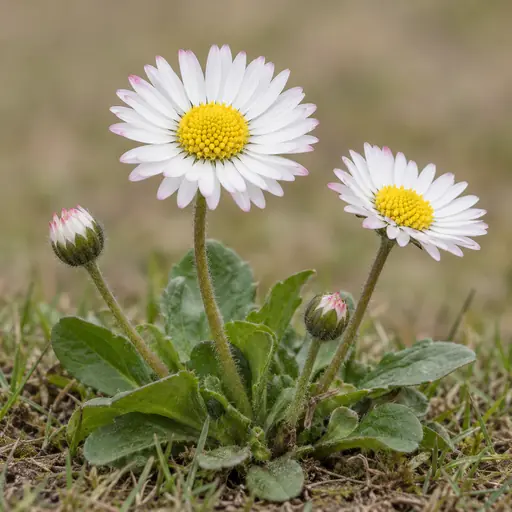
Small white flowers with yellow centres, close to the ground.
How to recognise it
The common daisy is a low plant. Its spoon-shaped, slightly hairy leaves form a flat rosette pressed to the ground. Each leafless, hairy stalk carries one flower head about 2 cm across. It has white rays, often tipped with pink, around a yellow centre. The heads close at night and in dull weather. Some plants look similar but are different. Oxeye daisy and other bigger daisy-like flowers grow on leafy stems. Mayweeds and chamomiles have feathery leaves.
Where it grows
It grows in lawns, short turf, grazed pastures, verges and paths, in sun on moist soil. You find it almost everywhere in Europe. It came to the US from Europe. There it now grows in lawns and damp, disturbed ground, most of all where summers are cool.
When
Where winters are mild it flowers almost all year. The main flush comes from spring into early summer. In cold regions and much of the US it flowers from spring to early summer. After that you see scattered flowers until frost.
Picking
Pinch off flower heads and a few young leaves. Take from many plants and leave the rosettes in place. Avoid lawns treated with weedkiller or fertiliser, places where dogs are walked and roadsides.
Cooking
Once you've identified it with certainty, you can eat the flowers and young leaves raw in small amounts. Use them in salads and sandwiches or as a garnish. They taste mild to slightly bitter and older leaves are tough. Rinse them gently in cool water. Try only a little at first. People allergic to the daisy family can react and large amounts can upset the stomach. Avoid it in pregnancy and while breastfeeding.
Keeping
Pick them just before use, as the flowers wilt quickly. Until then, keep them between damp paper towels in the fridge.
Sources: Identification and habitat: The Wildlife Trusts and NC State Extension. Cooking and safety: Colorado State University Extension and NC State Extension.
Always consult an expert before consuming any wild food. This information is for educational purposes only.