

Giant Puffball
Calvatia gigantea
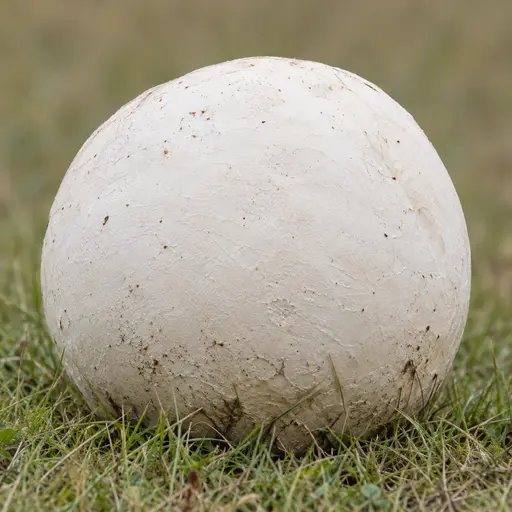
A smooth white ball, as big as a football or bigger, in meadows and pastures. Its flesh is firm and white, like fresh mozzarella.
How to recognise it
The giant puffball is a smooth white ball, often 20 to 50 cm across. It has a thin, leathery skin and no stem. A cord-like root joins it to the ground. Cut every one in half from top to bottom. The inside must be firm and pure white throughout, like fresh mozzarella. Any outline of a cap, gills or stem can mean a young Amanita still in its egg. That can be deadly. A thick, scaly, yellowish skin and a dark, purple-black inside mean an earthball (Scleroderma), which is poisonous. Yellow, olive or brown flesh means the spores are ripening. Then it is no longer edible.
Where it grows
Look in meadows, pastures, parks, gardens, hedgerows and woodland edges on rich ground. It often grows among nettles and often in the same place every year. It is widespread in Europe and the eastern US. In the dry interior West the similar western giant puffball (Calvatia booniana) grows in sagebrush and open grassland.
When
It grows from summer to autumn. In Europe that is mainly July to October. In the eastern US it is late summer to early autumn. It swells fast after warm, heavy rain.
Picking
Cut it at the base and take only firm ones that are white inside. One usually feeds several people. Leave old, yellowing ones to spread their spores. Avoid roadsides and lawns treated with chemicals.
Cooking
When you're sure of it, peel off the skin, which can be hard to digest. Then cook it. Fry thick slices in butter, or bread them first. It tastes mild and takes up other flavours. Try a small amount the first time.
Keeping
Keep it in the fridge and eat it within two days. Throw it away once the flesh turns yellow. Fried slices freeze well.
Toxic look-alikes
- Amanita phalloides · Deadly - do not eat
- Amanita virosa · Deadly - do not eat
- Amanita bisporigera · Deadly - do not eat
- Amanita ocreata · Deadly - do not eat
- Scleroderma citrinum · Toxic - do not eat
- Scleroderma polyrhizum · Toxic - do not eat
- Scleroderma areolatum · Toxic - do not eat
- Scleroderma verrucosum · Toxic - do not eat
- Scleroderma cepa · Toxic - do not eat
Sources: Identification and habitat: Missouri Department of Conservation and First Nature. Storage: ANSES. Season: GBIF records.
Always consult an expert before consuming any wild food. This information is for educational purposes only.