

Oyster Mushroom
Pleurotus ostreatus
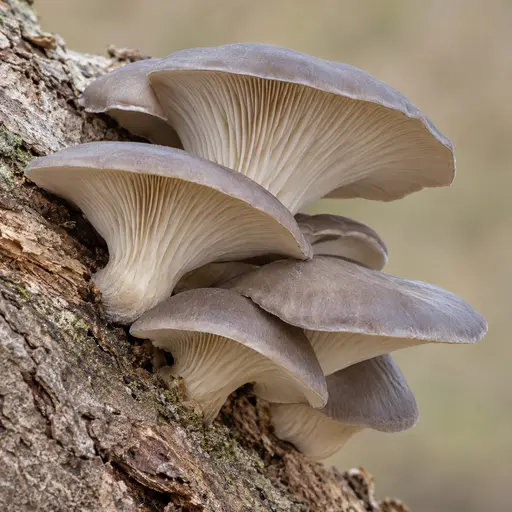
A white-grey mushroom with fan-shaped caps. It grows in clusters on dead wood.
How to recognise it
Oyster mushrooms have a shell- or fan-shaped cap, 5 to 18 cm across. It can be blue-grey, grey-brown or cream. They grow on wood in overlapping tiers. The white to cream gills run down into a short, off-centre stem, or there is no stem at all. The flesh is white and firm and the smell is mild. The spore print is white to pale lilac. Three look-alikes matter. The poisonous jack-o'-lantern (Omphalotus) is bright orange, gills included. It grows in tufts at the foot of trees. Sulphur tuft (Hypholoma fasciculare) has sulphur-yellow caps on central stems. Its gills are greenish-yellow and turn purple-brown. It tastes bitter. Angel wings (Pleurocybella porrigens) have been linked to deaths in Japan. They are pure white, thin and translucent. They grow only on rotting conifer wood.
Where it grows
It grows on dead or dying broadleaf trees, mainly beech. You also find it on poplar, willow, oak and ash (rarely on conifers). Look on standing trunks, stumps and fallen logs. It is common across Europe and North America.
When
This is a mushroom of late autumn and winter. A cold spell or the first frosts after rain set it off. In southern Europe it goes on into January or February. In the eastern US it fruits from October to early April.
Picking
Cut the cluster at the base with a knife. Take firm young caps and leave old or beetle-riddled ones. Some places need a permit for mushroom picking or set daily limits, so check the local rules.
Cooking
Be certain of the identification before you cook it. Cook it well and don't eat it raw. Trim the tough base and tear the caps into strips. Fry them hot until the edges crisp. The taste is mild and slightly sweet. It goes with garlic, butter, soy sauce and eggs.
Keeping
It spoils fast. Keep it in a paper bag in the fridge for a few days, or cook it and freeze it.
Toxic look-alikes
- Pleurocybella porrigens · Deadly - do not eat
- Omphalotus olearius · Toxic - do not eat
- Omphalotus illudens · Toxic - do not eat
- Omphalotus olivascens · Toxic - do not eat
- Omphalotus subilludens · Toxic - do not eat
- Hypholoma fasciculare · Toxic - do not eat
Sources: Identification and season: First Nature and MushroomExpert.com. Angel wings: Beaty Biodiversity Museum, University of British Columbia.
Always consult an expert before consuming any wild food. This information is for educational purposes only.