

Hedgehog Mushroom
Hydnum repandum
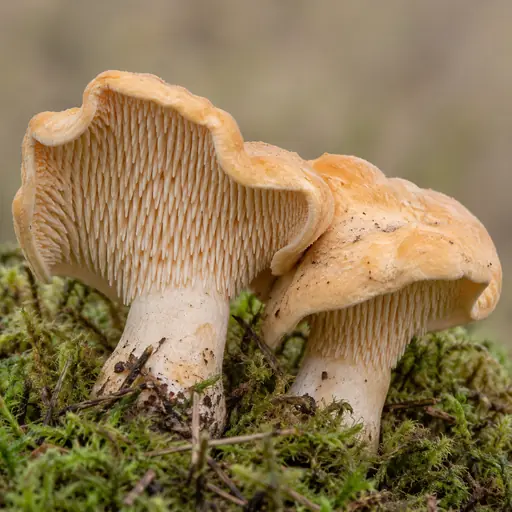
A buff to orange cap with soft spines underneath instead of gills. One of the safest wild mushrooms to learn.
How to recognise it
Turn it over. Under the cap you'll find soft, brittle spines 2 to 6 mm long, hanging like small icicles. There are no gills or ridges. The spines rub off easily. The cap is 4 to 15 cm across and cream to buff or pale orange. It is dry, velvety and often lumpy. The stem is white, solid and often off-centre. The firm white flesh slowly bruises yellowish to orange-brown. The terracotta hedgehog (Hydnum rufescens) is smaller and more orange. It has the same soft spines and so do the American Hydnum species. Other tooth fungi, such as Hydnellum and Sarcodon, are tough and corky or brown and scaly. Many of them are bitter.
Where it grows
It lives with conifers and broadleaf trees alike, such as spruce, pine, beech, oak and birch. Look in moss and leaf litter. It often grows in rings or rows. It is common across Europe (from the lowlands to the mountains) and across North America. On the US Pacific coast several Hydnum species grow under Douglas fir, tanoak and other trees.
When
In central and northern Europe it comes from late summer to late autumn, often until hard frost. In southern Europe the season is later and longer, running into winter. On the US Pacific coast it arrives with the autumn rains and carries on through the winter.
Picking
Cut it at the base. Brush off debris on the spot so it doesn't get stuck in the spines. Leave the small ones. In southern Bavaria and the Bavarian Forest it still carries caesium from Chernobyl. Eat it there only now and then.
Cooking
First be certain of your identification. Brush the cap. On large ones, rub off the spines. They break off in the pan and can taste bitter. Never eat it raw. Cook it well, fried in butter or braised. It tastes mild, nutty and sweet and has a firm, meaty bite. It is good with eggs, potatoes and game and in sauces.
Keeping
Because it is firm, it keeps better than most wild mushrooms. It lasts several days in the fridge in paper. For longer keeping, cook it and freeze it.
Sources: Identification: First Nature (UK) and MykoWeb (California Fungi). Caesium: German Federal Office for Radiation Protection (BfS). Season: GBIF records.
Always consult an expert before consuming any wild food. This information is for educational purposes only.