

Ramps
Allium tricoccum
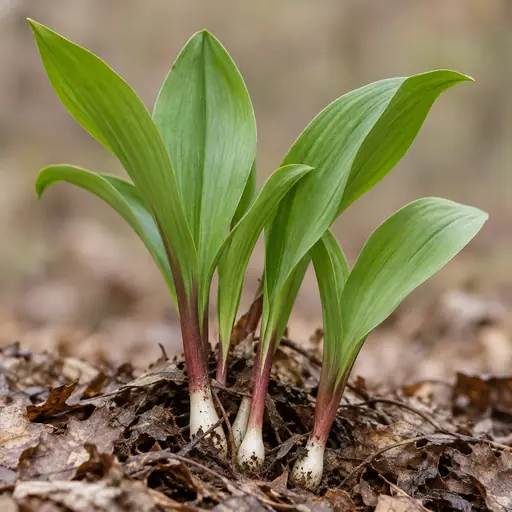
America's wild garlic: broad, smooth green leaves on purplish stems that smell strongly of onion and garlic.
How to recognise it
Ramps grow two or three broad, smooth, flat leaves straight from a small bulb in the ground. Each leaf has its own stalk, often purplish-red near the base. The leaves wither by early summer. After that, a leafless stalk carries a rounded cluster of small white flowers. Crush a leaf. Ramps smell strongly of onion and garlic. Their deadly look-alikes do not. But the smell stays on your fingers, so after the first few leaves the test proves nothing. Check every plant by its leaves and stalks too. False hellebore has pleated leaves set along an upright stem and grows in wet ground. Lily of the valley has two or three leaves wrapped around one another at the base. Autumn crocus, a garden escape, has stalkless leaves in a tuft. Appalachian bunchflower (Melanthium parviflorum) has similar basal leaves but no onion smell.
Where it grows
Ramps grow in rich, moist deciduous forest with deep leaf litter. Look on shaded slopes and in stream bottoms. They range from Quebec and New England through the Appalachians to Georgia and west to Minnesota.
When
The leaves come up from March in the southern Appalachians. Further north they appear in April and May. You get them in the few weeks before the trees leaf out. By late May or June they yellow and die back.
Picking
Take one leaf per plant, cut with a knife and leave the bulb. Digging it up kills the plant. It needs at least five years from seed to reach picking size. Ramps have declined in parts of their range. Great Smoky Mountains National Park bans picking. Some national forests limit it and ban selling. Quebec lists ramps as vulnerable and bans their sale. Check the local rules.
Cooking
Once you've identified them with certainty, you'll find the leaves taste of strong garlic and onion. Use a few raw, or wilt them briefly into eggs, potatoes, pasta and butter.
Keeping
The leaves keep a few days in the fridge, wrapped in a damp cloth. Chopped leaves, ramp butter and pesto all freeze well.
Toxic look-alikes
- Colchicum autumnale · Deadly - do not eat
- Convallaria majalis · Deadly - do not eat
- Veratrum viride · Deadly - do not eat
- Melanthium parviflorum · Deadly - do not eat
Sources: Identification, habitat and picking: NC State Extension and United Plant Savers. Look-alikes: Vermont Department of Health. Rules: National Park Service, USDA Forest Service and Quebec's environment ministry. Season: GBIF records.
Always consult an expert before consuming any wild food. This information is for educational purposes only.