

Golden Cap
Psilocybe cubensis
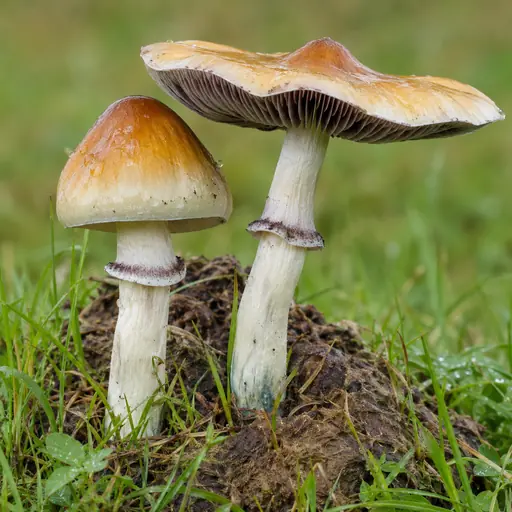
A golden-brown pasture mushroom with a white stem and a ring. It is the best-known magic mushroom. It contains psilocybin, which is being tested in clinical trials as a medicine for depression.
How to recognise it
The cap is 2 to 8 cm across. It starts as a rounded bell and opens out flat, often with a low bump in the middle. It is golden to caramel brown, paler at the edge. The surface is smooth and a little sticky. The gills are grey at first and turn purple-black, with white edges. The stem is white and hollow, 4 to 15 cm tall. A white ring sits near the top and turns dark from the falling spores. Every part bruises blue when you handle it. The spore print is purple-black. Several mushrooms in the same pastures are dangerous. The deadly Pholiotina rugosa and Galerina species are small and drop rusty-brown spores. Chlorophyllum molybdites is a large white mushroom with green spores. It causes severe vomiting. Panaeolus semiovatus looks similar but never bruises blue. Only an expert should tell them apart.
Where it grows
Look on cow dung and the rich pasture soil around it, sometimes on horse dung. It needs warmth and moisture. In the US it grows in the Gulf Coast states, from Florida to Texas. Florida has the most records.
When
It comes from May to October, a few days after warm, heavy rain. In Florida it can turn up in any month when it is mild and wet.
Picking
In most US states it is illegal to pick, keep or sell it, fresh or dried. Most pastures are private land too, so ask the owner before you walk in. Keep away from the cattle. If you want to find it, photograph it where it grows: the cap from above, the gills and the base of the stem.
Medicine
It is not a food. Psilocybin, the substance in it, is being tested as a medicine for depression and addiction. In those trials people get a measured dose with therapists present. Since 2023, approved psychiatrists in Australia can prescribe it for depression that other treatments have not helped. Eaten outside a trial, it can cause vomiting, stomach pain and panic attacks. Some people end up in hospital. Wild mushrooms vary a lot in strength. A look-alike can kill. Never take a wild mushroom as medicine.
Toxic look-alikes
- Galerina marginata · Deadly - do not eat
- Pholiotina rugosa · Deadly - do not eat
- Chlorophyllum molybdites · Toxic - do not eat
Sources: Identification and look-alikes: Stamets (1996), Singer and Smith (1958) and Allen and Merlin (1991), as cited by Wikipedia. Effects: First Nature. Medicine: Australia's TGA and ClinicalTrials.gov. Season: GBIF records.
Always consult an expert before consuming any wild food. This information is for educational purposes only.