
Liberty Cap
Psilocybe semilanceata
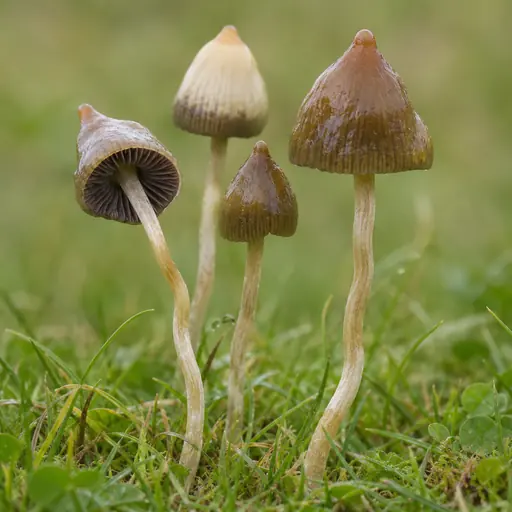
A small brown grassland mushroom with a pointed cap. It is Europe's most common magic mushroom. It contains psilocybin, which is being tested in clinical trials as a medicine for depression.
How to recognise it
The cap is small, 5 to 20 mm across. It is a pointed cone, usually with a little nipple on top. When wet it is brown and a little sticky. As it dries it pales to cream. The gills are olive-grey and turn purple-black as the spores ripen. The stem is thin, cream and usually wavy, 4 to 10 cm tall. Its base is sometimes blue. The spore print is very dark purple-brown. Other small brown mushrooms grow in the same grass. The deadly Pholiotina rugosa has a ring on its stem and rusty-brown spores. Deadly Galerina species have rusty-brown spores too. Only an expert should tell them apart.
Where it grows
Look in grassland grazed by sheep or cattle, on poor, acid soil that nobody fertilises. Think hill pastures, moorland edges, old meadows, parks and playing fields. It lives on dead grass roots and does not grow on dung. It is common in Britain, Ireland, Scandinavia and the Alps. In the US it grows on the Pacific coast, from northern California to Washington.
When
It comes from late August to December, mostly in October. Look a few days after rain, once the nights turn cool. On the US Pacific coast it comes a month later, mostly in November.
Picking
In most countries it is illegal to pick, keep or sell it, fresh or dried. That includes the UK, Ireland, Switzerland, the Netherlands and most US states. If you want to find it, photograph it where it grows. Take the cap from above, the gills and the base of the stem.
Medicine
It is not a food. Psilocybin, the substance in it, is being tested as a medicine for depression and addiction. In those trials people get a measured dose with therapists present. Since 2023, approved psychiatrists in Australia can prescribe it for depression that other treatments have not helped. Eaten outside a trial, it can cause vomiting, stomach pain and panic attacks. Some people end up in hospital. Wild mushrooms vary a lot in strength. A look-alike can kill. Never take a wild mushroom as medicine.
Toxic look-alikes
- Galerina marginata · Deadly - do not eat
- Pholiotina rugosa · Deadly - do not eat
Sources: Identification, habitat and effects: First Nature. Medicine: Australia's TGA and ClinicalTrials.gov. Season: GBIF records.
Always consult an expert before consuming any wild food. This information is for educational purposes only.