

Kawakawa
Piper excelsum
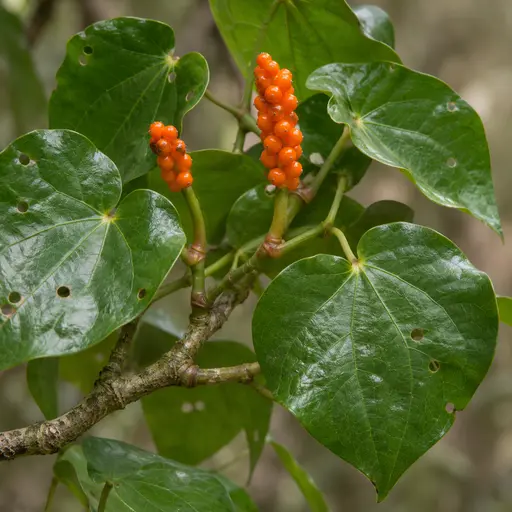
A New Zealand shrub with large, heart-shaped leaves and jointed stems. The peppery leaves make a traditional tea, and the ripe orange fruit is edible too.
How to recognise it
Kawakawa is a shrub or small tree, up to about 5 m tall. Its stems are jointed and zigzag, and they swell at each joint, a bit like bamboo. The leaves grow in pairs. Each leaf is dark green and glossy, 5 to 12 cm across and heart-shaped with a blunt tip. Five to seven veins fan out from the base. The leaves smell aromatic, and many of them are full of holes eaten by caterpillars. The flowers are tiny and sit on hard green spikes. On female plants these spikes turn into orange fruit spikes, made of tiny fruits packed tightly together. Karaka (Corynocarpus laevigatus) also has orange fruit in coastal forest. Each karaka fruit is a single oval fruit 3 to 4 cm long, and the tree has thick, leathery, oval leaves. The kernel inside the fruit is poisonous unless it has been prepared properly. Check the jointed stems and the heart-shaped leaves of every plant you pick, and don't eat a fruit you haven't identified.
Where it grows
Kawakawa grows only in New Zealand. It lives in the shade, in the understorey of coastal and lowland forest, and in warmer areas it reaches about 500 m. It is common from the far north of the North Island down to about Okarito, North Canterbury and Banks Peninsula. Frost kills it, so it stays near the coast and at low levels.
When
The leaves stay on the shrub all year. It flowers from August to November. Ripe orange fruit is most common from November to February and peaks in December and January. You can find a few fruit spikes at other times too.
Picking
Kawakawa is of great cultural importance to Māori. In rongoā Māori (Māori medicine) it is one of the most widely used plants, and practitioners still use it today. Pick with respect: take a few leaves from the sides of the shrub and never strip it bare. Leaves with insect holes are the ones traditionally preferred for tea. Wash them well and shake off any caterpillars. Plants growing in national parks, reserves and other conservation land are protected by law, so don't pick there. On private land, ask the owner. Respect any rāhui (a local ban).
Cooking
Once you're certain of it, wash the leaves well. For tea, boil a few fresh leaves in water for up to 10 minutes, strain it and drink it fresh. The leaves taste peppery. Dried and ground, you can use them like pepper on meat, or infuse them in sauces. Of the ripe fruit, people traditionally ate only the soft pulp and spat out the many small seeds. A New Zealand safety study was done on rats: they took the equivalent of four cups of tea a day for four weeks without harm. So drink it only now and then, and ask your doctor first if you are pregnant, breastfeeding or on medicines.
Keeping
Fresh leaves keep a few days in the fridge, wrapped in a damp cloth. For longer, dry them in a low oven and keep them whole or ground in a sealed jar. Ripe fruit is best on the day you pick it.
Sources: Identification and range: NZ Plant Conservation Network and Flora of New Zealand. Tea and uses: Te Ara and Manaaki Whenua Landcare Research. Safety study: Plant & Food Research (2019). Karaka: NZ Plant Conservation Network. Season: GBIF and iNaturalist records.
Always consult an expert before consuming any wild food. This information is for educational purposes only.