

Watercress
Nasturtium officinale
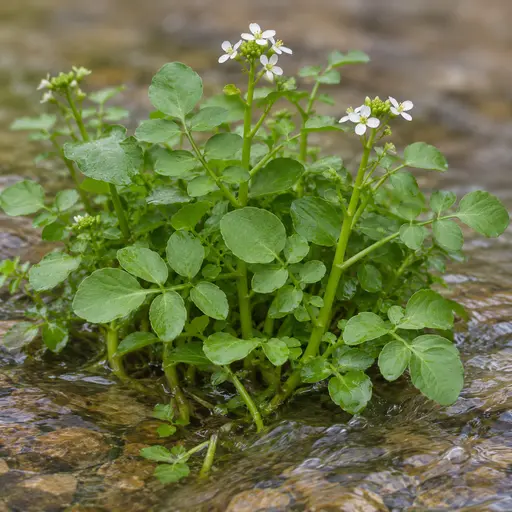
A peppery green that grows in clear, running water. It has rounded leaflets and small white flowers, and it grows wild all over New Zealand and in much of Australia.
How to recognise it
Watercress grows in running water and in the mud at the edge. It makes soft green mats of trailing, hollow stems that root where they touch the ground. Each leaf is divided into a few rounded to oval leaflets with smooth or slightly wavy edges. The leaves are mostly under 10 cm long. Small white flowers sit in short clusters at the stem tips. Later they give narrow, curved pods about 1 to 2 cm long. Fool's watercress (Helosciadium nodiflorum, called water celery in New Zealand) grows in the same streams and is often mistaken for it. Its leaflets are toothed, its leaves are much longer and its flowers form flat, umbrella-shaped clusters. Hemlock (Conium maculatum) grows on creek banks in both countries. Every part of it is poisonous and it can kill. Its hollow stems have purple blotches, and its finely divided leaves smell harsh when crushed. A plant with finely divided leaves or umbrella-shaped flower heads is not watercress. Check the leaf shape and the flowers of every plant you pick, and never taste an unknown plant to test it.
Where it grows
Look in running water: streams, springs, drains and muddy edges where the water is shallow. It came from Europe and Asia as a salad plant. It has gone wild across New Zealand (since the 1850s) and in Victoria, Western Australia, South Australia, Queensland, New South Wales and Tasmania. It often grows in streams that run through farmland, and that is exactly where it is least safe.
When
It grows all year as long as the water keeps running. It does best in the cooler months and in spring. It flowers from spring to autumn. Pick the young tips, because the thick stalks are coarse.
Picking
Safety comes first here. Wild watercress can carry liver fluke (a parasite that sheep and cattle spread) and germs from farm runoff. Health authorities in New Zealand advise against eating stream watercress unless it has been washed and cooked thoroughly in boiling water. So pick only from clean, fast-running water with no paddocks, farm drains, towns or roads upstream, and cook all of it. Cut the young tips with scissors above the water and leave the rest. Don't drop pieces into another stream: it regrows from stem fragments. Ask before you go onto farmland. In New Zealand, check that the stream has no rāhui (a local ban put in place by iwi).
Cooking
Once you're certain of it, cook it before you eat it. Wash it well, then boil or steam it thoroughly. Raw wild watercress doesn't belong in a salad or on the plate as a garnish. Use it like spinach: in soup (with potato, for example), omelettes, quiches and stews. In New Zealand it also goes into the boil-up, a one-pot stew. Māori call it wātakirihi or kōwhitiwhiti. They have used it widely as a cooked green and to wrap food in the hāngi (earth oven).
Keeping
It wilts very fast, so cook it the day you pick it or the day after. Until then keep it in a paper bag in the fridge. Finished soup freezes well.
Sources: Identification and range: VicFlora and NZ Plant Conservation Network. Safety advice: NZ Director-General of Health, NZ Ministry for Primary Industries and US CDC. Hemlock: Weeds Australia and NZ Plant Conservation Network. Māori use: Manaaki Whenua Landcare Research. Season: GBIF records.
Always consult an expert before consuming any wild food. This information is for educational purposes only.